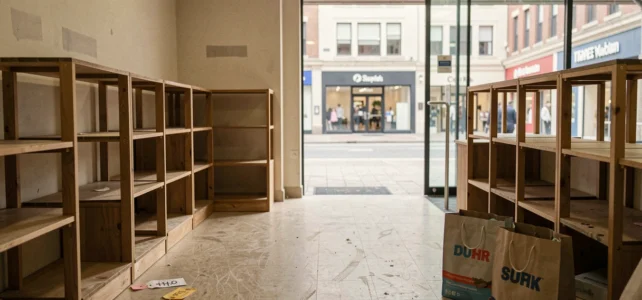
Christine Laure, a ready-to-wear brand founded in 1961 in Gray, saw its historic company LES CREATIONS LTN placed in judicial liquidation by the commercial court of Dijon on December 1, 2025. However, the brand has not disappeared: its assets were sold to the holding company Amoniss, the parent company of Pimkie, approved by the Competition Authority in the summer of 2026.
This transfer reshapes the future of a brand that still had 127 stores and 284 employees just a few months before the liquidation.
Liquidation of LES CREATIONS LTN and sale of Christine Laure’s assets: legal timeline
The distinction between the company and the brand is the starting point for any analysis. LES CREATIONS LTN, the historical legal structure of Christine Laure, requested its placement in judicial recovery on August 28, 2024. At that time, the brand claimed to have 145 stores in France (including 51 affiliates), 380 employees, and a turnover of 61 million euros for 2023.
The observation period was extended in January 2025. Despite the internal plan called Horizon 2026 put forward by management, the network shrank to 127 stores and 284 employees. The commercial court of Dijon ultimately converted the procedure into judicial liquidation on December 1, 2025.
This shift opened the way for an asset sale, rather than a continuation of the company. Since the definitive closure of Christine Laure under its original legal form, the future of the brand relies on a classic mechanism of corporate insolvency law: the acquisition by a third party of the exploitable elements (brand, stock, affiliate contracts) without taking on the liabilities.
| Date | Event | Consequence |
|---|---|---|
| August 28, 2024 | Judicial recovery of LES CREATIONS LTN | Observation period, debt freeze |
| January 2025 | Extension of the observation period | Maintaining the reduced network (127 stores) |
| December 1, 2025 | Judicial liquidation | Search for a buyer for the assets |
| August 5, 2026 | Decision 26-DCC-167 of the Competition Authority | Authorization of the acquisition by Amoniss |

Decision 26-DCC-167: what the concentration control reveals about the acquired scope
Most articles mention the acquisition of Christine Laure by Amoniss without detailing the regulatory framework. The decision 26-DCC-167 of August 5, 2026 provides significant clarifications on the nature of the operation.
The Competition Authority authorized the exclusive control of Christine Laure’s assets by Amoniss within a simplified procedure. The reasoning is based on two observations: the operation does not pose a serious risk to competition in the women’s ready-to-wear market in France, and it helps preserve a network of stores as well as jobs in a sector marked by closures and job protection plans.
The acquired scope includes the Christine Laure brand itself, the available stock, and the contracts binding the brand to its affiliated stores. However, the company LES CREATIONS LTN remains in liquidation. The accumulated debts, the leases of the stores not acquired, and any potential social disputes are not part of the sold lot.
What the simplified procedure means
A simplified concentration control procedure indicates that the Authority did not identify any problematic overlap between Amoniss’s activities (which controls Pimkie) and those of Christine Laure. The two brands target distinct customer segments by age and price positioning.
This quick green light also suggests that the acquired network is significantly smaller than the original one. A network of 145 stores could have raised more questions about local concentration in certain shopping malls.
Christine Laure under Amoniss: the constraints of a revival in physical ready-to-wear
The acquisition by Amoniss does not guarantee a return to the previous situation. Several structural factors weigh on the viability of a network of stores in shopping malls targeting women over 40, sizes 36 to 52.
- The affiliate store model, which represented about a third of the network before the recovery, relies on independent partners. Convincing these affiliates to continue under a new legal structure requires presenting them with attractive commercial conditions and a brand whose image has not been too damaged by the liquidation.
- The physical ready-to-wear sector in France continues to lose points of sale. Store closures are not unique to Christine Laure: they also affect both fast fashion and the mid-range segment.
- The loyal customer base is the brand’s main intangible asset. Customers accustomed to larger sizes and accessible positioning do not automatically switch to other brands if Christine Laure reopens under Amoniss.
Potential complementarities with the Pimkie network
Amoniss already has a logistics infrastructure and expertise in network management through Pimkie. Potential complementarities include pooling purchases, negotiating commercial leases, and possibly sharing some retail spaces.
Conversely, the risk of cannibalization remains limited. Pimkie targets a younger clientele with a fast fashion positioning, while Christine Laure positions itself in a more classic segment with a broader size range. The two brands do not address the same buyers.
Christine Laure brand in 2026: online sales and repositioning
The question of online sales remains open. Before the recovery, Christine Laure had an e-commerce site whose contribution to overall turnover was not dominant. For a brand whose strength relied on in-store advice and physical fitting, digital represents a growth lever but also a significant investment.
The repositioning of the brand will depend on Amoniss’s choices regarding range and pricing. Maintaining the Christine Laure identity (sizes 36 to 52, accessible women’s ready-to-wear, French roots) while modernizing the offer is a delicate balance. Changing too much would mean losing the historical customer base. Changing nothing would expose the brand to the same difficulties that led to the liquidation of LES CREATIONS LTN.
The decision of the Competition Authority has set the legal framework. The real fate of Christine Laure now plays out in the commercial arena: the number of reopened stores, maintaining the affiliate network, and the ability to attract new customers without losing the old ones. The coming months will determine whether the brand founded in 1961 in Gray embarks on a second life or remains a name on a liquidation judgment.