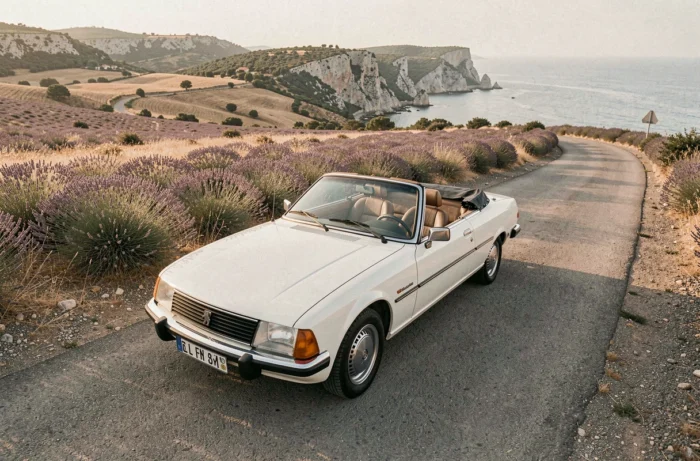
The Peugeot 305 was never included in the official catalog in convertible form. Only the sedan and the station wagon were marketed between 1977 and 1989, with over 1.6 million units produced. Talking about a Peugeot 305 convertible means discussing a handcrafted transformation, a prototype, or a modification made in a workshop. This particular status changes everything: the driving experience, administrative procedures, and maintenance constraints are nothing like those of a production sedan.
Peugeot 305 convertible: a body style that never existed in series
Have you spotted a 305 with an open roof in a classified ad or at a gathering? It is certainly a modification made after production. Peugeot did not offer any convertible variant of the 305. Sports projects or style studies, like the 305 Rallye initially planned with a V6, never resulted in mass production.
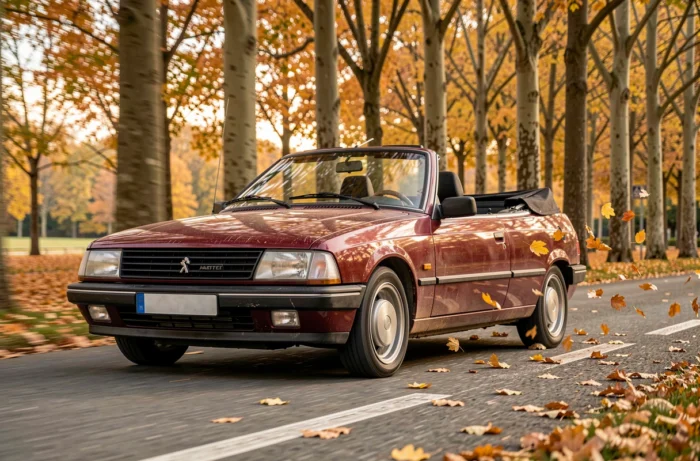
This reality has a direct consequence: every 305 convertible is a body transformation. However, modifying a vehicle’s structure (number of seats, body type) raises the question of individual approval. In France, a vehicle whose technical characteristics have been significantly altered may require new homologation from the DREAL.
If you are considering adopting the Peugeot 305 convertible, the first step is to check the vehicle’s compliance. A poorly reinforced roof cut compromises the rigidity of the body, which directly affects road handling and passive safety.

Collector’s registration and old 305: criteria and limits
The Peugeot 305 is over 30 years old, is no longer produced, and thus meets two of the three criteria to qualify for collector status on the registration document. The third criterion poses more problems: the vehicle must not have undergone major modifications to its technical characteristics, particularly the body.
A 305 transformed into a convertible risks being denied this status. The certificate issued by the manufacturer or by the FFVE (Fédération Française des Véhicules d’Époque) concerns the authenticity of the model. A change in body type constitutes precisely the kind of alteration that can block the process.
Concrete advantages of collector’s registration
For a 305 that remains compliant with the original (sedan or station wagon), collector status brings real benefits:
- Technical inspections spaced five years apart instead of two for vehicles manufactured after 1960, which eases the burden of administrative maintenance.
- The possibility of driving in certain Low Emission Zones (ZFE), even without a compatible Crit’Air sticker, thanks to local exemptions granted to collector vehicles.
- Insurance rates often lower than those of a standard car insurance, with specialized collectors’ insurers offering contracts suited for non-daily use.
For a handcrafted convertible version, these advantages become uncertain. The owner is left with an old vehicle that accumulates constraints: no collector status, biannual technical inspections, and potential ZFE restrictions.
Open-top driving based on the 305: what the mechanics change
Driving a 305 with the top down indeed transforms the sensations. The original sedan, especially in series 2 from 1982, offered decent road behavior with more precise steering and more powerful engines than the first generation. Removing the roof alters this balance.
The structural rigidity of a sedan partly relies on the roof. Without it, body flex increases. On a rough road, this results in unwanted noises, creaks, and a feeling of floatiness that the original 305 did not present. Reinforcement of the floor and the side rails is necessary to compensate for the loss of rigidity.
Engines and manual transmission
The engine range of the 305 included small gasoline engines to diesels that had reliability issues in the first generation. The GTX and GTI versions had more powerful mechanics. In an open version, engine noise and wind add to the experience: a naturally aspirated four-cylinder gasoline engine without roof insulation produces a raw sound, far from the muffled tones of a closed sedan.
The manual transmission, standard on most 305s, remains a strong point. Its short throw and gearing are well-suited for enjoyable driving at moderate speeds, exactly the range of a leisurely convertible.
Insurance and daily use of a modified 305
The insurance for a modified classic car does not follow the same rules as that for a homologated collector vehicle. Specialized insurers generally require that the vehicle complies with its original technical specifications or that it has valid individual approval.
A 305 convertible without specific homologation may only be offered third-party insurance, with exclusions in case of a claim related to the structural modification. Before any purchase, requesting a quote from a broker specialized in classic vehicles allows for assessing the real cost.
Daily use also raises the question of ZFE. Since their gradual deployment in major French urban areas, classic vehicles without an appropriate Crit’Air sticker are restricted. Only collector status on the registration document grants access to ZFE exemptions, which brings us back to the compliance issue mentioned earlier.
Driving a Peugeot 305 with the top down remains a unique experience, halfway between the popular French automobile of the 1980s and the raw pleasure of a handcrafted convertible. The charm is real, but it requires verifying every technical, administrative, and insurance aspect before hitting the road.