
The market for connected devices aimed at men is no longer just a race for specifications. Since September 2026, two European regulations have significantly changed what manufacturers must integrate into their products: the Data Act mandates access to personal data generated by devices, and the AI Act regulates the transparency of embedded artificial intelligence systems. These two texts redefine the selection criteria for anyone equipping themselves with smartwatches, connected rings, or smart glasses.
Data Act and connected devices: what changes for the user
Since September 12, 2026, any new connected product marketed in the European Union must allow its user to access the data it generates. Article 3(1) of the Data Act requires that this data be available by default, in a usable format, securely and free of charge.
In practical terms, a connected sports watch or a physiological tracking ring can no longer lock heart rate, sleep, or activity readings in a proprietary app without offering an export option. The user must be able to retrieve their data and, if they wish, transfer it to another service.
To follow tech news on Masculin, this type of regulatory evolution is as significant as the release of a new gadget: it transforms the relationship between man and his everyday devices.
This change has a direct impact on the wearables market. Manufacturers who relied on a closed ecosystem to retain their customers must rethink their strategy. Data portability becomes a concrete purchasing criterion, alongside battery life and design.
Connected rings and watches: from gadget to medical device
Men’s wearables are evolving towards a quasi-medical function. The sensors embedded in connected rings measure heart rate variability, skin temperature, and deep sleep quality. Studies published in Frontiers in Physiology explore the correlation between this data and broader clinical indicators.
Limitations to keep in mind
A wearable does not replace a medical diagnosis. Optical sensors on the finger or wrist remain sensitive to movement, ambient temperature, and skin pigmentation. Accuracy varies depending on usage conditions.
- Sleep data provides useful trends but not a clinical polysomnogram.
- SpO2 measurement on the wrist has a higher margin of error than a medical oximeter.
- Irregular heart rate alerts detect certain patterns but cannot confirm a diagnosis of arrhythmia.
Smart glasses and AI transparency obligations
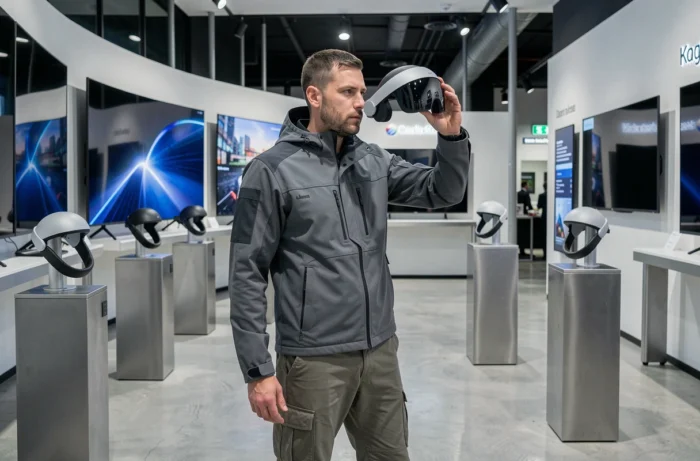
Connected glasses are gaining ground in the male universe. Their use ranges from discreet photo-taking to heads-up display of notifications, including real-time translation. Wearable technology raises privacy questions that go beyond just being a gadget, and several recent cases highlight the need for a clear framework.
The AI Act adds a regulatory layer. Since August 2, 2026, Article 50 requires that users be informed when interacting with an artificial intelligence system. Synthetic content (images, voices, generated texts) must carry machine-readable labeling. For systems already on the market, a transitional period runs until December 2, 2026.
What this changes for embedded assistants
Glasses equipped with an AI voice assistant, personalized sports coaching apps, or photo editing tools integrated into smartphones are directly affected. All AI-generated content must be identifiable as such. A man using an assistant to draft a message or edit a selfie will see traceability mentions on the produced content.

Male tech ecosystems: chargers, USB-C, and interoperability
The standardization around USB-C, already mandated for smartphones in the European Union, is gradually extending to accessories. Multi-port wall chargers, external batteries, and wireless charging stations are converging towards a single standard.
This approach illustrates an underlying trend: tech accessories are no longer sold in isolation but as part of a coherent ecosystem. Manufacturers now offer complete ranges integrating audio, wearables, and home automation under a single brand.
- A next-generation GaN multi-port charger simultaneously powers a smartphone, watch, and earbuds with tailored power for each device.
- External batteries now include screens indicating the charge distribution among the ports.
- Qi2 wireless charging stations improve magnetic alignment to reduce energy loss.
The main selection criterion remains the total power of the charger and its ability to distribute it intelligently. A charger advertised as high power but limited to a single port at full charge loses its appeal as soon as two devices are plugged in.
The regulatory convergence (Data Act, AI Act, mandatory USB-C) and the evolution of wearables towards health functions are reshaping equipment priorities. The next relevant tech purchase is not the one with the longest specifications sheet, but the one that guarantees access to one’s own data, transparency regarding embedded AI, and compatibility with the rest of the ecosystem.