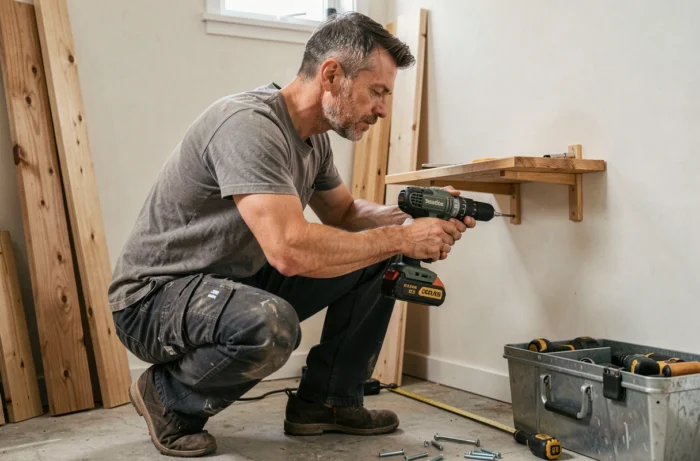
Training in DIY to gain autonomy at home is measurable: the cost of a professional intervention for a common repair far exceeds that of the materials alone. DIY training helps bridge this gap by acquiring the technical skills necessary to carry out your own work. The next step is to identify which expense categories truly justify this investment in time and learning.
Cost of a tradesperson versus cost of materials: the real differences by type of work
The labor portion in a work invoice varies significantly depending on the trade. Comparing these differences allows you to target the most profitable skills to acquire in DIY training.
| Type of work | Estimated labor share | Return on learning |
|---|---|---|
| Interior painting | Majority (more than half of the quote) | Very high |
| Installation of laminate or vinyl flooring | Significant | High |
| Common plumbing (faucets, seals) | Variable, often high for small interventions | High |
| Electricity (replacement of outlets, switches) | High on small jobs | Moderate (standards to comply with) |
| Simple carpentry (shelves, fixtures) | Moderate | High |
Painting and flooring installation are the areas where labor represents the largest share of the quote. They are also the most accessible tasks for a beginner guided by a trainer.
Common plumbing repairs (changing a seal, replacing a faucet) illustrate another scenario: the intervention sometimes lasts less than an hour, but the travel and hourly rate of the tradesperson inflate the bill. Learning these tasks in a practical course eliminates this recurring extra cost.
Consulting the Bricoludik training space for the adaptation of each module to your level allows you to prioritize skills according to your housing and actual needs.
Tax credit and small DIY: a tax lever often overlooked
DIY training aims for autonomy, but some tasks remain occasionally delegable. Since 2026, the immediate advance of the tax credit for personal services changes the game for outsourced small DIY.
The CESU+ system from Urssaf now applies a 50% tax credit in real-time, without waiting for the next year’s income declaration. For services like “handyman,” the annual ceiling for eligible expenses is set at 500 euros for small DIY.
In practice, this means that a household that trains in common tasks but occasionally delegates a specific task (heavy fixture, work at height) can optimize this residual expense tax-wise. Training and targeted outsourcing do not oppose each other: they complement each other in a logic of overall savings.
What the tax credit does not cover
Structural renovation work (electrical panel work, embedded plumbing, insulation) does not fall under personal services. It is precisely in these areas where the autonomy gained in DIY training generates the most significant savings, as no tax advantage reduces the tradesperson’s bill.
Profitable DIY skills: where to start your training
Not all training modules are equal in terms of return on investment. Three areas stand out when crossing the frequency of intervention and avoided costs.
- Painting and coatings: these are the most frequent tasks in a home, and the technical gestures (surface preparation, roller application, touch-ups) can be learned in a few hours of guided practical workshops.
- Surface plumbing: replacing seals, installing a mixer, unclogging. These repairs occur regularly and require inexpensive tools. Mastering plumbing avoids the majority of emergency calls to a plumber.
- Fixtures and light carpentry: knowing how to choose an appropriate anchor for the surface (drywall, brick, concrete), level a shelf, or assemble a piece of furniture requires little equipment but precise know-how that DIY courses convey quickly.
On the other hand, electricity requires knowledge of current standards. Training often covers the replacement of a switch or outlet, but work on the electrical panel remains the responsibility of a certified professional.

Basic tools: initial investment and amortization period
Training in DIY involves building a toolbox. A common mistake is to buy professional equipment right from the start or to accumulate unnecessary tools.
A versatile toolbox covers the majority of common tasks: drill-driver, level, measuring tape, screwdriver set, adjustable pliers, hand saw, hammer. These tools pay for themselves from the first interventions done by yourself.
Buy gradually according to projects
Trainers recommend investing as projects arise rather than buying a complete kit. A plumbing course identifies the specific keys and fittings you will need. A painting workshop specifies the type of roller suitable for your surface.
This gradual approach avoids impulsive purchases in stores and ensures that each tool bought corresponds to a real use. The most cost-effective tool is the one you know how to use correctly, not the most expensive one on the shelf.
Home DIY training or group workshop: two formats, two logics
Home coaching allows you to work directly on your project, with your constraints (type of wall, room configuration, condition of installations). The trainer adapts the content to the specific project. This format is suitable for those who have an identified project and want to carry it out themselves.
Group workshops in stores or training centers offer a more structured framework, often thematic. They are suitable for acquiring general skills before diving in. The group format generally costs less per hour of training.
The choice depends on your situation: a specific renovation project leans towards individual coaching, while a gradual skill enhancement points towards workshops. In both cases, practice guided by a qualified professional remains the determining factor in the confidence gained to DIY later on your own.
The cost difference between doing it yourself and hiring someone is measurable from the first intervention completed by yourself. DIY training does not eliminate the occasional need for a tradesperson, but it reduces it to situations that truly require it, while making every euro spent on materials more effective.