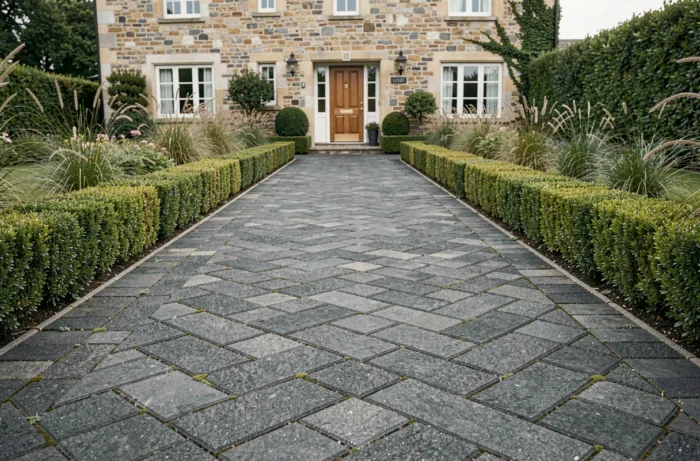
Concrete paving remains the most commonly installed surface for garden paths in France, driven by its affordable cost and the variety of formats available. However, the context in which this material is chosen has changed: Local Urban Planning Plans now incorporate permeability constraints that influence both the type of paving and its installation method. Choosing concrete paving for a path is no longer just a question of aesthetics or budget.
Standard NF P98-335 and Minimum Slope: What Your Path Must Comply With
A technical point determines the durability of any paved path: the standard NF P98-335.
This standard governs the implementation of concrete pavers and slabs on pedestrian walkways and driveways. It requires a minimum slope of 1.5% on all impermeable surfaces to ensure proper drainage of rainwater. In practical terms, on a garden path a few meters long, this slope translates into a slight but measurable elevation, which must be integrated from the very beginning of the earthworks.
A concrete paver laid flat, without adhering to this slope, promotes water stagnation. Some installers consider the slope optional for a private pedestrian path, whereas the standard does not make this distinction. If you hire a landscaper, ensure they are familiar with this regulatory reference. A quote that does not mention the preparation of the laying bed or the slope profile should be questioned.
To delve deeper into the selection criteria for a surface suitable for your project, the concrete paver according to Une Autre Maison details the trade-offs between formats, uses, and technical constraints.
Drainage Concrete Paver or Classic Paver: The Impact of the PLU on Your Choice
Since 2024, an increasing number of French municipalities are including obligations or strong incentives in their PLU to use permeable surfaces for outdoor developments. This evolution aligns with the objectives of Zero Net Artificialization (ZAN).
For a garden path, this translates into two distinct scenarios:
- A classic concrete paver laid on a sand bed with tight joints forms an almost impermeable surface. In municipalities that strictly enforce the ZAN, this type of installation may be rejected or subject to compensatory measures (retention basin, landscaped swale).
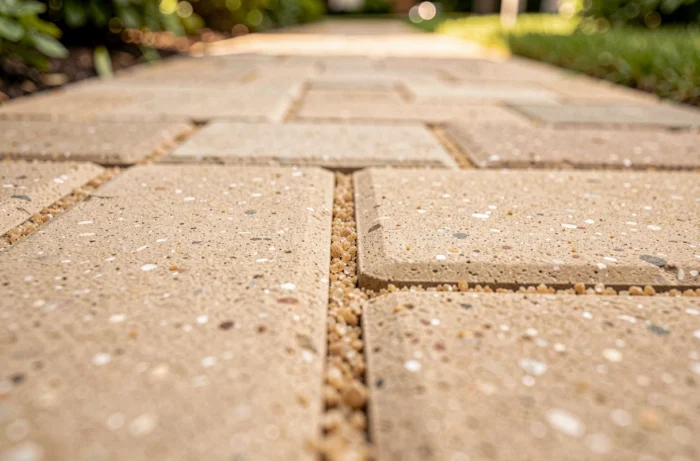
- A drainage concrete paver, designed with internal porosity, or a classic paver laid with open joints on a permeable bed, allows water to infiltrate directly into the soil. This choice meets regulatory requirements without radically altering the budget.
- Pavers with a cellular structure (like grass pavers) constitute a third option, but their visual appearance and walking comfort differ significantly from traditional concrete pavers.
Before choosing your paver, consult your municipality’s PLU. This document, available at the town hall or online, specifies whether your area imposes a land coverage coefficient or a minimum permeable surface rate. Ignoring this verification can lead to a compliance refusal during an inspection or resale.
Thickness and Use: Pedestrian Path or Driveway with Concrete Pavers
The distinction between a pedestrian path and a driveway is not about comfort but about mechanical resistance. A concrete paver intended for regular vehicle passage requires a significantly greater thickness than that of a pedestrian walkway.
The NF P98-335 standard defines minimum thicknesses according to traffic class. For a strictly pedestrian garden path, pavers a few centimeters thick are usually sufficient. For a garage entrance where a car passes daily, the required thickness increases, and the laying bed must also be sized accordingly (compacted gravel foundation layer).
A common pitfall is choosing a paver that is aesthetically appealing but too thin for actual use. An aged appearance concrete paver, highly valued for its look in garden paths, sometimes exists only in pedestrian thickness. Laid in front of a garage, it cracks within a few seasons.
The Laying Bed Conditions Longevity as Much as the Paver
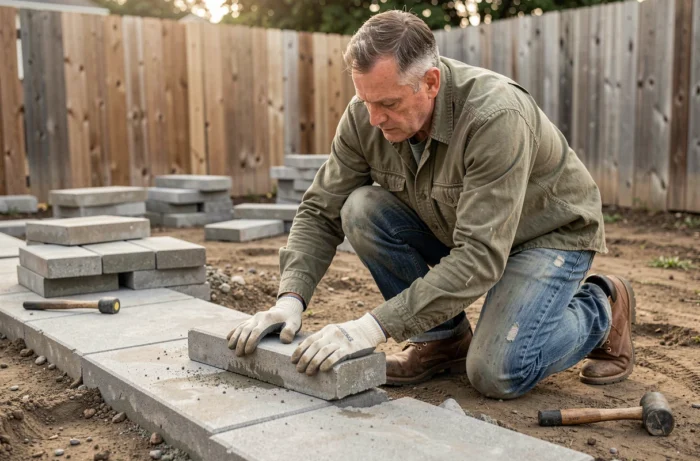
A concrete paver of good thickness laid on a poorly prepared laying bed will not perform better than a paver that is too thin on a proper foundation. The compaction of the foundation layer, the grain size of the laying sand, and the lateral support by borders are parameters as crucial as the paver itself.
A localized subsidence almost always originates from the subsoil, not from the paver. If your land has clayey areas or poor natural drainage, soil preparation will represent a significant portion of the total budget, sometimes as much as the material itself.
Color and Finish of Concrete Pavers: Aging and Heat Effect
The aesthetic choice of a concrete paver – color, texture, finish – has practical consequences that are often underestimated. A dark concrete paver (anthracite, black) absorbs more heat than a light paver. Recent research on urban surfaces shows that reflective surfaces measurably reduce local temperature.
For a garden path bordered by vegetation, a dark paver in full sun can create an unpleasant microclimate in summer and accelerate the drying of adjacent plants. Light shades (beige, light gray, stone tone) also visually age better, as stains and moss are less contrasted – or more, depending on the exact color.
The surface finish (smooth, shot-blasted, bush-hammered, aged) influences slip resistance. A smooth finish becomes slippery in wet weather, which poses a safety issue on a sloped path. Prefer a textured surface if your path has any elevation.
Choosing a concrete paver for a garden path commits you for several decades. The available data do not allow for the designation of a universally superior format or color, because each project combines its own soil constraints, local regulations, and usage. The PLU, the thickness suitable for actual traffic, and the quality of the laying bed determine the durability of the paver much more than its surface appearance.