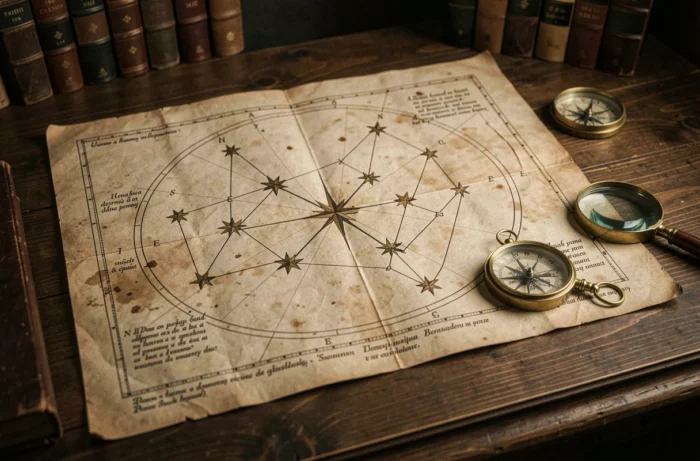
On a a flag, a jewel, or an ancient monument, a group of seven stars draws the eye without one always knowing why. This motif transcends time and continents, carried by the symbolic weight of the number seven. Understanding what these seven stars represent is to trace a thread that connects ancient astronomy, sacred texts, and modern political projects.
Why the number seven structures so many symbols
Before discussing stars, one must understand why seven appears everywhere. Seven days in the week, seven musical notes, seven colors in the light spectrum. This recurrence is not a coincidence of nature.
In antiquity, astronomers counted seven celestial bodies visible to the naked eye: the Sun, the Moon, Mercury, Venus, Mars, Jupiter, and Saturn. These celestial bodies served as markers to organize time and space. The seven-day calendar directly stems from this, with each day associated with a planet.
Among the Dogon people of West Africa, seven represents the union of opposites, the sum of the feminine (four) and the masculine (three), thus a form of human perfection. In Christian tradition, the seven days of Creation establish seven as a number of fulfillment. In Islam, the first seven verses of the Quran hold a foundational place.
Kabbalah, for its part, identifies a seventh sphere in the Tree of Life. This is not a symbol fixed within a single culture: seven functions as a point of convergence between traditions.
An in-depth article on the meaning of the symbol of the 7 stars allows one to gauge how much this number permeates areas as diverse as religion, art, and politics.
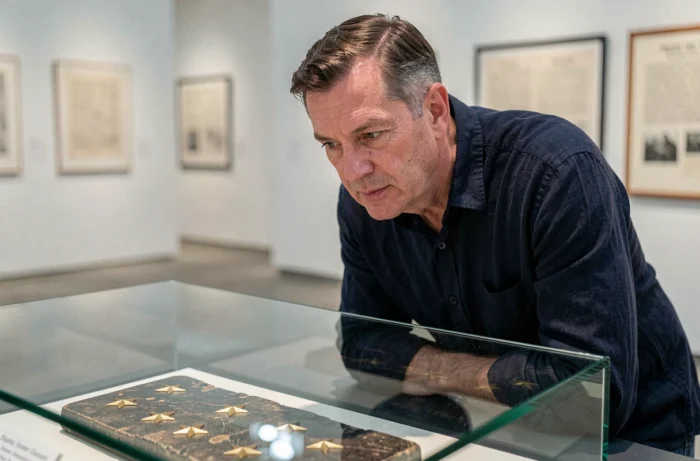
The seven-pointed star in sacred geometry and esotericism
You may have noticed that the pentagram (five points) and the hexagram (six points) are ubiquitous in popular culture? The seven-pointed star, however, remains discreet. This rarity is not trivial: it gives it a unique status.
It is called heptagram. Its geometric construction is more complex than that of its cousins, as the number seven does not easily divide within a circle. This technical difficulty has fueled the idea that the figure conceals knowledge reserved for initiates.
The seven rays of theosophy
At the turn of the twentieth century, esoteric movements reinterpreted the seven-pointed star. Theosophy, in particular, developed the concept of the “seven rays,” associating each branch with a plane of consciousness or a principle of nature. Rudolf Steiner extended this interpretation by linking the seven branches to the seven astral bodies.
A pedagogical document from the Grand Palais dedicated to the artist Hilma af Klint shows that this theosophical interpretation remains alive in contemporary artistic circles. Af Klint used the seven-pointed star in her abstract compositions long before abstract art was recognized as such.
Menorah and Jewish tradition
One of the oldest incarnations of the seven-pointed motif is the Menorah, the seven-branched candelabrum described in the Hebrew Bible. Each branch holds a light, and the whole symbolizes divine presence. The Menorah has been chosen as the official emblem of the State of Israel, proof that the motif has traversed millennia without losing its strength.
Little-known fact: during the creation of the State of Israel, an alternative project proposed seven stars as a national symbol. These stars then embodied a modern political program as much as a religious heritage.
Seven stars on flags: a living political symbol
Leaving the sacred realm does not make the seven stars disappear. Several national flags display them, each with its own interpretation.
- The flag of Venezuela features an arc of seven stars, representing the provinces that signed the declaration of independence. Each star corresponds to a founding territory.
- The flag of the Community of the Pleiades (a grouping of Turkic-speaking nations) uses seven stars linked to the Pleiades constellation, visible for millennia and a navigation marker for the nomadic peoples of Central Asia.
- In European heraldry, configurations of seven stars appear on coats of arms of cities and regions, often in reference to the seven hills, seven founding families, or seven historical privileges.
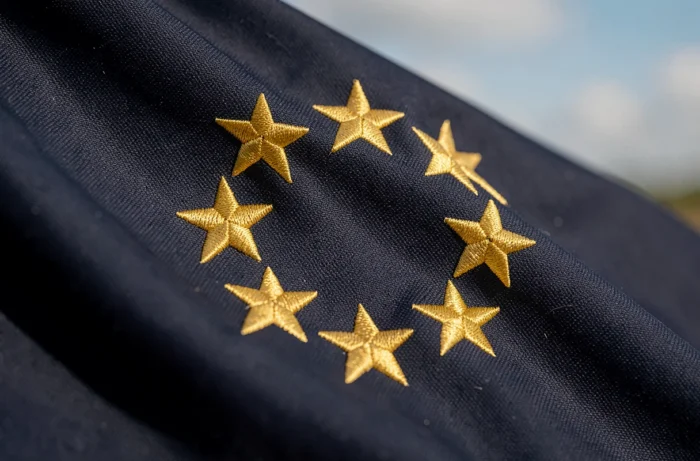
On a flag, the seven stars always tell a story of foundation. They indicate who participated in the birth of a community. The sacred symbol transforms into a legal and political act.
Protection, jewelry, and contemporary uses of the symbol
Why do we find the heptagram on pendants, rings, or tattoos? The appeal is not solely aesthetic.
In several traditions, the seven-pointed star is associated with protection. Each branch represents a day of the week, a planet, or a force. Wearing this symbol would mean surrounding oneself with complete balance, without blind spots.
Jewelry featuring this motif plays on this dual reading: decorative object and talisman. Sacred geometry fuels a market where the form conveys an intention. A pentagram evokes folk magic, a hexagram refers to Jewish tradition. The heptagram, on the other hand, suggests a more personal spiritual quest, less codified.
Beyond jewelry, the symbol appears in meditation or visualization practices. Practitioners use it as a focus support, with each branch serving as a focal point for a theme of reflection (balance, creativity, wisdom, for example).
- In lithotherapy, the heptagram is sometimes associated with amethyst, a stone linked to intuition and spiritual elevation.
- In numerology, seven remains the number of introspection and inner search.
- In architecture, seven-lobed rose windows adorn certain medieval buildings, although they are rarer than those with five or six divisions.
The common thread of all these uses can be summed up in one word: seven marks a boundary between the visible and the invisible. It lies just beyond six, the number of material completeness, and opens onto a plane perceived as superior or hidden.
The seven stars do not tell a single story. They condense centuries of reflection on the cosmos, the sacred, and human organization. Whether on the Menorah, a national flag, or a silver pendant, the motif retains this rare ability: to say much with a simple form.