The animation and music segment today accounts for between 5 and 10% of the overall budget for a wedding in France. This means that every euro invested must create a real moment of celebration, not a gadget forgotten after dessert. We have selected ten animation formats that work well in practice, tested at receptions of all sizes, prioritizing those that create real interaction among guests.
1. Personalized perfume workshop among guests
The perfume creation workshop remains one of the most underrated formats. A professional perfumer sets up a table with about twenty raw materials, and each guest composes their fragrance in an individual bottle.
This format works particularly well during the cocktail hour when groups do not yet know each other. The handling of scent strips and the olfactory vocabulary create an immediate conversation starter. Allow about thirty minutes per rotation of six to eight participants.
To explore this type of service further, the animations offered on Cœur de Mariage cover a wide range of participatory formats suitable for different venue configurations.
2. Live painter during the ceremony
An artist sets up their easel facing the ceremony stage and creates a canvas in real-time. Guests see the artwork progress throughout the day, from the “I do” to the first dance.
The finished canvas becomes the main keepsake of the wedding, much more than a classic photo album. The format is silent, non-intrusive, and requires no active participation from guests, making it compatible with any other highlight of the reception.
3. Mixology bar with signature cocktails
The trend of themed bars with a professional mixologist has seen significant growth in French weddings since 2024. The principle: a bartender creates two or three exclusive recipes for the couple, named after them or related to their story.
A signature cocktail bar effectively replaces a static cocktail hour. Guests mingle, watch the preparation, and chat around the counter. Providing a mocktail option for guests who do not consume alcohol remains a logistical requirement that should not be overlooked.
4. Customized escape game around the reception venue
The wedding escape game leverages the geography of the reception venue: park, cellar, outbuildings. A team of game designers creates a scenario related to the couple (finding the lost wedding ring, for example) with puzzles scattered throughout the space.
This format mixes tables and forces guests who do not know each other to collaborate. We recommend scheduling it between the cocktail hour and the meal, for a maximum duration of forty-five minutes, to avoid disrupting the catering service rhythm.
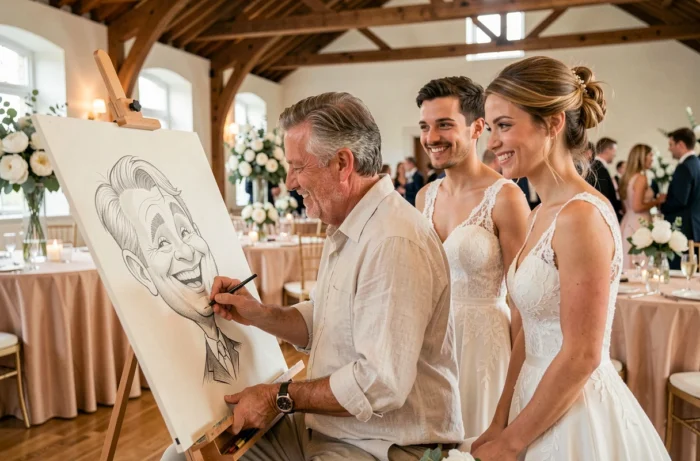
5. Caricaturist circulating during the meal
A caricaturist moving from table to table during dinner creates a different effect than a photobooth. The drawing takes two to three minutes per portrait, generating a mini-show at each table, with the reactions of neighboring guests.
The portraits leave with the guests as a physical keepsake. This format requires no technical setup, no sound system, and works equally well indoors or on a terrace.
6. Flash dance lesson before the first dance
Rather than leaving the dance floor empty for twenty minutes after the first dance, a dance instructor teaches a simple choreography to all guests. Rock, salsa, or waltz depending on the wedding style.
The lesson lasts about fifteen minutes. Its real benefit: it encourages guests reluctant to dance for the rest of the evening. Couples who have tried it find that the dance floor remains full much longer after this collective start.
7. Blind tasting to liven up the time between courses
Wine, cheese, chocolate, or olive oil: the blind tasting transforms a lull between two services into a participatory activity. A sommelier or artisan presents five to six samples, and tables compete to identify the products.
- Provide printed answer sheets per table to structure the game and keep a record
- Adapt the tasting theme to the wedding region (local wines, regional products)
- Limit the duration to twenty minutes to avoid encroaching on the next service
8. Vintage photo booth with instant printing
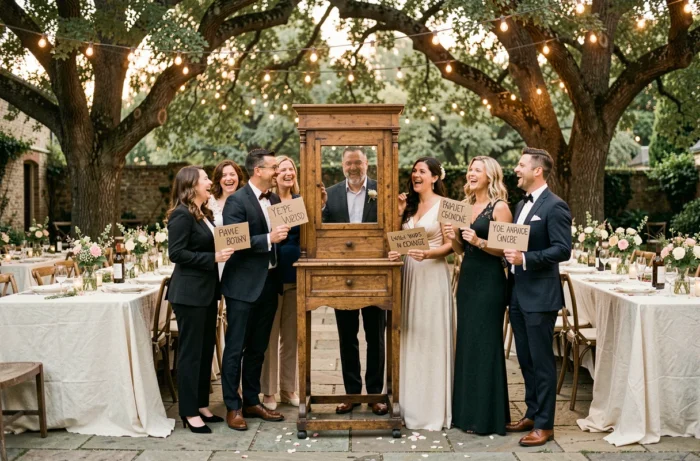
The photobooth remains a classic, but the vintage curtain booth with immediate silver print changes the game. The grain of the paper, the strip format of four poses, and the wait of a few seconds before development create a ritual that digital cannot replicate.
Physical prints are kept by guests long after the evening, unlike digital files often forgotten on a phone. Setting up the booth near the guestbook allows for combining the two: a strip glued on the page, a note written beside it.
9. Close-up magic show between tables
A close-up magician works less than a meter from guests, using cards, coins, and borrowed objects from the table. This format works better than a stage show at a wedding because it adapts to the ambient noise level and does not require interrupting the music.
We observe that the best slots are during the cocktail hour and dessert. During the meal, transitions between courses also work, but coordination with the caterer is necessary to avoid blocking service.
10. Interactive wish wall replacing the guestbook
The traditional guestbook suffers from a recurring issue: most guests write only a generic line. A wish wall, made up of cards to hang on a wooden or wire support, changes the mechanics.
- Each card poses a different question (a memory with the groom, a couple’s advice, a challenge for the first year)
- The short card format eliminates the blank page syndrome
- The wall becomes a decorative element visible throughout the reception
The 2026 trend confirms this shift towards animations centered on guests’ experiences rather than spectacular performances. A memorable wedding relies on the quality of interactions among guests, not on the accumulation of services. Four well-placed animations throughout the day will always have a greater impact than ten formats strung together without a break.