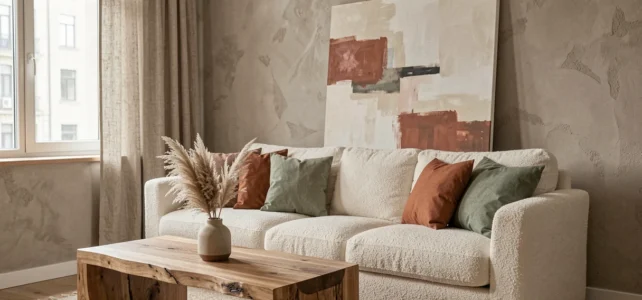
What indicators allow us to distinguish a sustainable decor trend from a passing fad in 2024? Between the rise of refurbished furniture, the surge in online purchases in the mid-range segment, and the return of natural palettes, the signals do not all point in the same direction. This article compares the major decor directions of the year through their market data and their concrete translations piece by piece.
Interior Decoration Market in 2024: Purchasing Channels and Circular Supply Chains
Inspiration articles list colors and styles but overlook how purchases are structured. Industry studies cited by Courrier du meuble et de l’habitat show that digital accounts for about 17 to 20% of furniture and decoration sales in France, with double-digit growth in the mid-range.
This shift towards omnichannel (physical stores, 3D configuration, online ordering) directly modifies what we find in interiors. Generalist and specialized marketplaces make design pieces that were previously reserved for showrooms accessible, and the catalogs available on espace-deco.be illustrate this diversification of supply sources for a coherent decor project.
On the end-of-life side, Ecomaison’s 2025 report confirms a generalization of the act of depositing used furniture. These volumes feed a growing reserve of materials and refurbished pieces, directly usable in decoration projects. The 20-39 age group is massively adopting this practice, resulting in interiors that mix new and second-hand, particularly in small urban spaces.
| Criterion | New online purchase | Refurbished furniture |
|---|---|---|
| Market share (trend) | Increasing, double-digit growth in mid-range | Strongly progressing, driven by 20-39 year-olds |
| Impact on interior style | Wider access to contemporary design and foreign ranges | Mixed aesthetic, vintage pieces integrated into a modern decor |
| Circular supply chain | Packaging, logistical returns | Reuse via Ecomaison, local refurbishment |
| Dominant buyer profile | All age groups, price sensitivity | Young urbanites, small spaces |
Natural Colors and Bright Shades: Two Palettes Coexisting in the Living Room and Bedroom
Competitors often present the 2024 palettes as a uniform block. Data shows a coexistence of two color families with distinct uses depending on the room.
Earthy Tones and Moss Greens for Rest Spaces
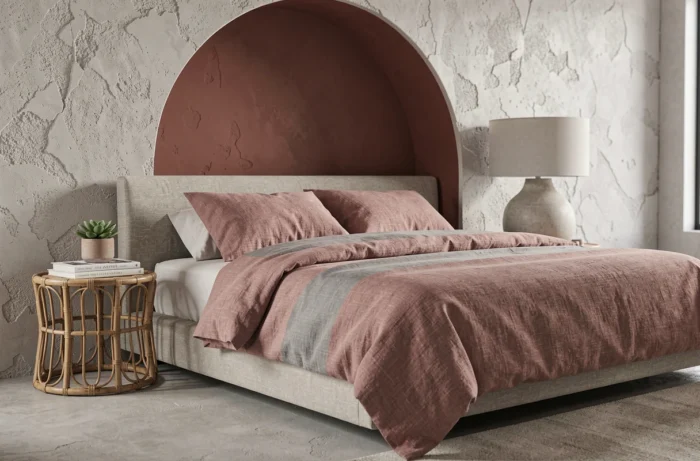
Terracotta, sandy beige, warm brown, and moss green dominate bedrooms and reading corners. These shades align with the biophilic design trend, which brings nature indoors through color as much as through materials. They work particularly well with certified wood and sustainable textiles like organic linen.
Earthy colors visually stabilize small spaces, a direct advantage for urban apartments where space is limited.
Klein Blue, Orange, and Bright Pink in the Living Room
The living room remains the space for expression. Bright colors (Klein blue, orange, red) are used in color blocking or targeted accents: a rug, an armchair, a wall section. The approach differs from total maximalism: the occasional color accent replaces complete saturation of the room.
In contrast, these saturated shades do not work well in bedrooms, where they disrupt the perception of calm. The choice of palette thus depends less on a global trend than on the function assigned to each space.
Decoration Materials 2024: Chrome, Marble, and Leather in a Context of Sustainability
Three materials stand out this year, but their actual adoption varies depending on the budget and the room in question.
- Chrome adds a modern shine to lighting and furniture legs. Its cost remains accessible, which explains its massive presence in mid-range lines sold online.
- Marble (or its large-format ceramic stone imitations) adorns countertops and bathrooms. Large-format coverings limit visible joints and simplify maintenance.
- Leather, associated with a vintage aesthetic, is making a comeback in living room seating. Refurbished leather is gaining ground thanks to reuse channels, offering a lower price than new for a sought-after patina.
The common point between these three materials: their compatibility with a mixed new-second-hand interior. A vintage leather sofa pairs seamlessly with a marble coffee table ordered online.
Sustainable Design and Vintage Furniture: What Collection Volumes Reveal About Interior Style
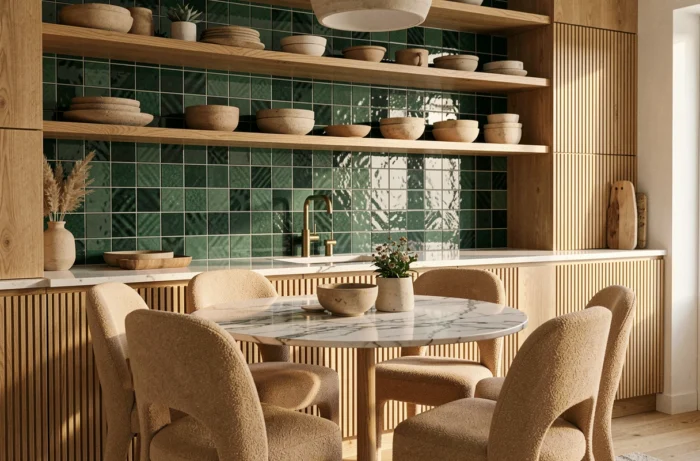
Vintage furniture is no longer a militant choice. The generalization of Ecomaison collection points and the growth of the second-hand market create a steady supply of pieces from the 70s and 80s, two decades whose aesthetics strongly mark 2024 interiors.
Cantilever chairs, teak sideboards, and brass lighting are found in modern compositions where they play the role of visual accent. The difference from previous years lies in the available volume: the refurbishment channel now feeds a continuous flow, not just occasional finds at flea markets.
This relative abundance has a direct effect on interior design. New furniture designers incorporate retro codes (tapered legs, pronounced curves, matte finishes) so that their pieces coexist with authentic vintage. The style of each piece is built through coherent accumulation rather than by purchasing a complete range.
Piece-by-Piece Decoration: Concrete Choices for an Interior in 2024
Applying these trends requires different choices depending on the space. Here are the most relevant decisions:
- Living Room: prioritize a unique color accent (armchair, rug) against a neutral background, pair a vintage piece with contemporary online furniture.
- Bedroom: earthy palette, natural fiber textiles, indirect lighting. Avoid cold chrome in favor of brass or wood.
- Kitchen: large-format coverings to limit maintenance, marble or ceramic stone imitation countertops, chrome metal stools for contrast.
- Home Office: the functional Scandinavian piece remains the reference, complemented by a refurbished seat for comfort and budget.
The structuring data of 2024 remains the growing share of digital in decoration purchases. It redistributes access to ranges, shortens lead times, and pushes physical stores to reposition themselves on advice and staging. For a decor project, comparing prices between marketplaces and local stores is no longer optional; it is the first reflex to adopt.