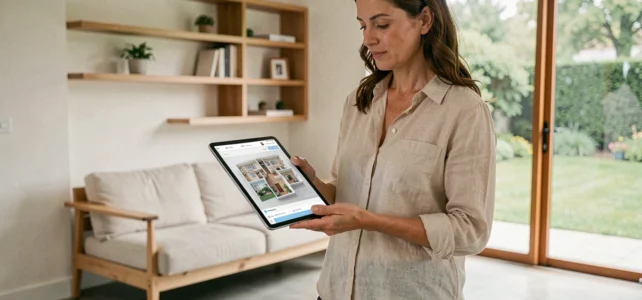
Are you looking for real estate online and come across a series of still photos? It’s impossible to know if the hallway is narrow, if light truly enters the living room, or if the kitchen connects with the living area. The virtual tour solves this problem by allowing you to navigate freely through each room from your screen. Lamaison360 offers this type of immersive experience, accessible for free, for both individuals and real estate professionals.
360-degree technology and image quality: what makes a virtual tour usable
Not all virtual tours are created equal. The difference lies in two technical points: the resolution of the panoramas and the fluidity of navigation between rooms.
A 360-degree panorama captured in high definition allows you to zoom in on a detail (electrical outlet, condition of a tile joint, type of glazing) without the image becoming blurry. It is this level of precision that transforms a simple visual curiosity into a decision-making tool.
Navigation relies on anchor points placed in each room. You click, moving from the living room to the bedroom, then to the bathroom. If these points are poorly positioned or too far apart, the feeling of immersion disappears. When using the free virtual home tour with Lamaison360, the guided tour scripts the journey so that each transition between rooms remains natural.
The fluidity of navigation is as important as image resolution. A sharp panorama but poorly connected to other rooms creates a choppy experience that discourages potential buyers.
The real cost of a virtual real estate tour: why free changes the game
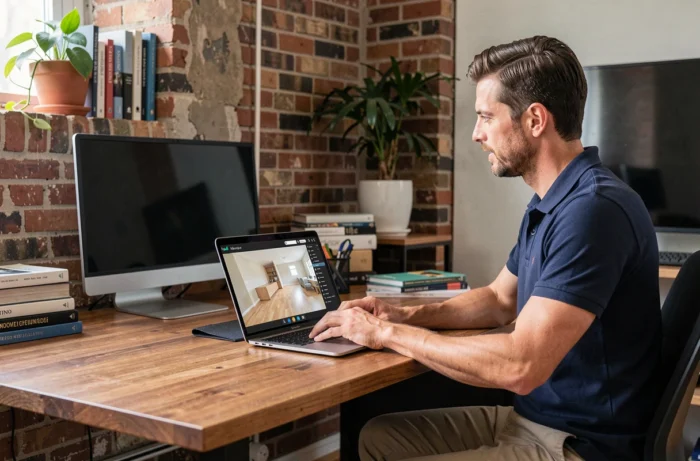
Have you noticed that most real estate listings in France still do not offer a virtual tour? According to industry analyses reported in 2026, only 15 to 20% of listings include a 3D tour. The main barrier remains the price.
The cost of a professional virtual tour like Matterport has significantly decreased in recent years. We have moved from a high range (around 4.50 to 9 euros per square meter) to a more accessible range, between 2.50 and 4.50 euros per square meter. For an average-sized apartment, the bill still amounts to several hundred euros.
This is where Lamaison360’s free approach makes sense. By removing the financial barrier, the platform allows sellers or independent agents to offer an immersive tour without budgetary trade-offs. The model relies on the mobile application and integrated tools, not on a service charged per square meter.
What free does not sacrifice
Free does not mean degraded. The elements to check to ensure this are:
- The ability to navigate in full screen, on mobile as well as on computer, without visible loss of sharpness
- The integration of an interactive map that situates each room within the entire property
- Compatibility with major browsers, without the need for additional plugin installation
A free tool that meets these three criteria covers the needs of most common real estate projects.
Concrete impact on sales: numbers from the field
The virtual tour is not just a marketing argument. A French study covering over 15,000 transactions measured tangible effects on the sales process.
The sales cycle shortens by about 32% when an immersive tour accompanies the listing. In other words, a property that took three months to find a buyer now takes about two months.
Another concrete figure: the number of unnecessary physical visits decreases by 40%. Buyers who visit after exploring the property in 360 degrees are already convinced by the layout of the space. They come to confirm an impression, not to discover the property.
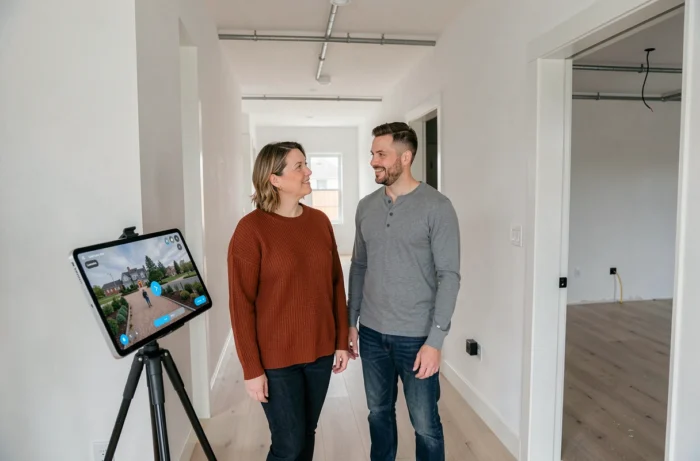
For the real estate agent, this natural selection of visitors represents a significant time saving. Fewer blocked slots for visits without follow-up, more qualified appointments.
Which properties benefit most from a virtual tour
The 3D tour does not provide the same added value for all types of properties. It makes a difference especially in three cases:
- Houses with an atypical layout (mezzanine, extension, half-levels) where photos are not enough to understand the flow
- Properties located far from the living area of potential buyers, typically second homes or professional relocations
- New programs in VEFA, where the future buyer cannot physically visit a property that does not yet exist
The more difficult it is to visualize the property in photos, the more decisive the virtual tour becomes.
Digital accessibility and virtual tours: an underestimated angle
French regulations on digital accessibility are gradually strengthening. The RGAA (General Reference for Improving Accessibility) imposes standards on public services and increasingly on private platforms.
For a virtual tour, this means that navigation must remain usable via keyboard, contrasts must be sufficient, and text alternatives must describe the spaces for visually impaired individuals.
Few 3D tour solutions integrate these constraints from the design stage. Lamaison360, as a public mobile application, aligns with this accessibility logic. An accessible tool reaches a wider audience, without additional effort for the seller.
This criterion deserves to be checked before choosing a virtual tour solution: ask if the platform meets at least the RGAA level AA criteria. If the answer is vague, the risk is to publish content that is inaccessible to part of the potential buyers.
The free virtual tour is no longer a gadget reserved for high-end agencies. With the decrease in production costs and the arrival of tools like Lamaison360, it is becoming an accessible standard. The real choice is no longer between doing or not doing a 3D tour, but between a tool that properly scripts the experience and a poorly assembled panorama that detracts from the property more than it enhances it.