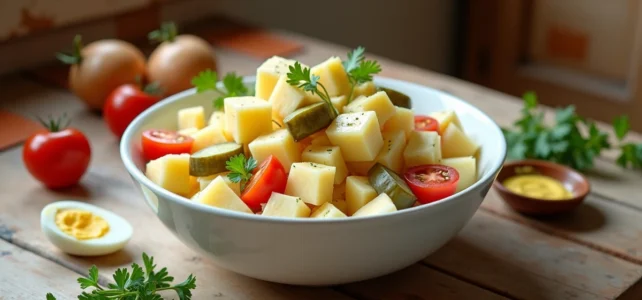
The Piemontese salad has an energy density that varies from one recipe to another, sometimes doubling. We regularly observe significant discrepancies between an industrial catering version and a homemade preparation. Understanding these differences allows us to make informed choices without falling into common shortcuts.
Fat/Carbohydrate Ratio: The Real Caloric Lever of Piemontese Salad
Mayonnaise is the dominant lipid component of the recipe. Potatoes, often blamed, provide complex carbohydrates and potassium. Their glycemic index mainly depends on cooking and cooling methods.
Cooked and then cooled potatoes develop resistant starch, which lowers the glycemic response compared to hot mashed potatoes. This well-documented phenomenon in nutrition makes Piemontese salad more interesting in terms of carbohydrates than a hot starch dish.
White ham, naturally lean, contributes little to the total caloric content. Hard-boiled eggs provide high-quality protein, choline, and vitamin D. The problem is never the egg or the ham, but the amount of mayonnaise per serving. To delve deeper into the issue, discover our analysis on does Piemontese salad make you gain weight.
Industrial Versions: Notable Formulation Discrepancies
The nutritional labels of different brands reveal significant variations. The difference lies in the proportion of sauce and the possible addition of oil in the recipe.
Industrial versions also contain emulsifiers, mustard, and sulfites (a frequently overlooked allergen). We recommend always reading the ingredient list rather than relying solely on the caloric count displayed on the front.

Piemontese Salad and Weight Gain: The Consumption Context Matters More Than the Recipe
Piemontese salad is a picnic dish, a summer buffet item, or a catering tray. This service context raises a specific nutritional issue: the portion size is beyond the consumer’s control. In individual trays, portions often exceed 200 g, which mechanically doubles the energy intake compared to 100 g.
An outdoor meal also includes bread, sugary drinks, and dessert. The Piemontese salad is just one element of an overall caloric platter. Attributing weight gain to a single dish is a classic analytical error in nutrition.
Frequency of Consumption vs. Single Portion
A dish with moderate energy density does not lead to weight gain if consumed occasionally within a balanced energy intake. The relevant question is not “how many calories in 100 g” but “how often and in what quantity”.
Lightened Piemontese Salad Recipe: Substitutions That Change the Nutritional Profile
Lightening a Piemontese salad without altering its essence requires modifying the sauce, not the solid ingredients. Here are the substitutions we recommend:
- Replace classic mayonnaise with a mixture of 0% fat cottage cheese and a teaspoon of mustard. The total lipid content drops drastically while maintaining creaminess.
- Keep the whole hard-boiled egg: removing the yolk to “save calories” eliminates choline and vitamin D without significant savings.
- Increase the proportion of pickles and tomatoes. The lycopene in tomatoes provides antioxidant benefits, and the volume of vegetables enhances satiety without adding calories.
With these adjustments, homemade Piemontese salad sees its caloric intake significantly reduced, placing it on par with a classic mixed salad.
Enriching with Protein Without Weighing Down
To transform Piemontese salad into a protein-rich main dish, we add sliced grilled chicken or diced smoked tofu. The portion of ham alone provides a modest protein contribution. Adding protein enhances satiety and reduces post-meal snacking, which is more important than the caloric count of the dish itself.
Dietary Balance and Piemontese Salad: Moving Beyond Isolated Dish Reasoning
Thinking in terms of “this food makes you gain weight” or “this food makes you lose weight” has no nutritional relevance. It is the overall energy balance over several days that determines weight changes. Even in its classic version, Piemontese salad remains a moderate-calorie preparation compared to a gratin dauphinois, a quiche lorraine, or a croque-monsieur.
For those in dietary rebalancing, homemade Piemontese salad offers a triple advantage:
- A source of complex carbohydrates from cooled potatoes (resistant starch).
- Complete proteins from eggs and ham.
- A cold preparation that can be easily portioned on a scale, unlike hot dishes served with a ladle.
Piemontese salad does not cause weight gain; uncontrolled portions and excessive mayonnaise do. Adjusting the sauce and weighing your portion transforms this summer dish into an option perfectly compatible with weight maintenance or loss goals. The real risk lies in industrial versions overloaded with fats and in buffet contexts where the consumed quantity escapes any reasonable estimation.