
The Saphir service of Air France centralizes all requests related to disability, but its actual functioning remains poorly understood, even by regular travelers. Understanding assistance codes, request deadlines, and pricing subtleties helps avoid issues on the day of departure.
SSR Codes and Request Process: What Happens on the System Side
Each assistance request with Air France is based on a SSR code (Special Service Request) recorded in the reservation file. The WCHC code designates a completely immobile passenger, the BLND a blind passenger, and the DEAF a deaf passenger. These codes determine the resources mobilized on the ground and on board.
The request must reach Air France at least 48 hours before departure. This deadline is not a recommendation: it is the condition for the service to be guaranteed. After this threshold, the airline does its best but without contractual obligation. We recommend making the request as soon as the reservation is made, either online or via the Saphir service by phone.
For passengers who wish to learn more about the disabled fare and assistance at Air France, the process always goes through this same dedicated channel, distinct from the regular customer service.
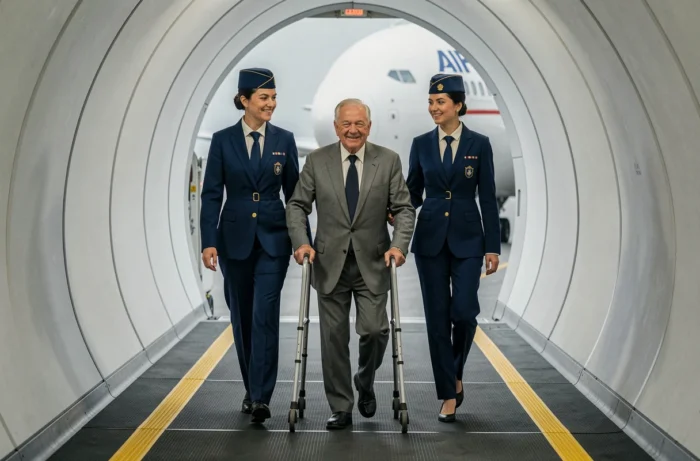
Mandatory or Optional Accompaniment: Real Criteria of Air France
Air France does not systematically require the presence of an accompanying person. The basic rule is clear: the passenger must be able to understand safety instructions and apply them in case of evacuation. If this criterion is met, traveling alone is permitted, regardless of the type of disability.
An accompanying person becomes mandatory in three specific cases:
- The passenger cannot understand or apply safety instructions independently (severe cognitive disability, profound intellectual deficiency).
- The passenger cannot fasten or unfasten their seatbelt, put on a life jacket, or move to an emergency exit without direct physical assistance.
- A medical certificate (MEDIF form) indicates that the presence of a third party is required for medical reasons during the flight.
When the accompanying person is deemed mandatory by Air France after reviewing the medical file, the airline applies a discount on the accompanying person’s ticket. This reduced fare is not automatic: the mandatory nature must be validated by Air France’s medical service, not simply declared by the passenger.
Cognitive, Psychological, or Mental Disabilities: Case-by-Case Assessment
Air France allows the majority of people with cognitive or psychological disabilities to travel alone. The assessment focuses on the ability to understand the crew’s verbal instructions and to react appropriately in an emergency situation. In case of doubt, the Saphir service requests a MEDIF form filled out by the treating physician.
Passengers with an invisible disability (autism spectrum disorders, severe anxiety disorders) can report their situation to benefit from tailored assistance at the airport, without triggering a requirement for accompaniment.
Wheelchairs and Mobility Aids in Hold: Transport Rules
The personal wheelchair is transported free of charge, in addition to the standard baggage allowance. This exemption covers manual wheelchairs, electric wheelchairs, and mobility aids (walkers, crutches). The electric wheelchair requires a battery compliant with IATA air transport regulations: lithium-ion batteries must generally be disconnected and protected against short circuits.
We observe that delays and damages during the return of wheelchairs remain a recurring point of friction in the airline industry. Air France usually returns the wheelchair at the aircraft door or at the jet bridge, but handling issues in the hold can lead to delays. Reporting the fragility of the equipment at the time of handover is a useful precaution.
Guide Dog and Assistance Dog in Cabin
The guide or assistance dog travels free of charge in the cabin on Air France flights, provided that the passenger provides documentation certifying the dog’s status (identification card, training certificate). The dog must remain on the floor, at the passenger’s feet, for the entire duration of the flight. The request must be indicated at the time of booking to ensure an appropriate location.

Placement of the Accompanying Person: European Regulatory Evolution
The strengthened European framework now includes the obligation for airlines to place the accompanying person next to the disabled passenger at no charge. This provision, integrated into the update of EU261 rules, aligns the treatment of companions of disabled persons with that of adults accompanying children under 14 years old.
In practice, a gap persists between this obligation and the online booking experience. Early selection of specific seats remains charged if it does not go through the dedicated assistance channel. In other words, booking through the Saphir service or the assistance line allows for free placement, while the standard web process applies the usual seat selection fees.
This technical point often causes confusion. A passenger who books online without going through Saphir may be charged for the seat selection for their accompanying person, even though they are entitled to it for free. The solution is simple: always finalize seat placement through the assistance service, even if the initial booking was made online.
Disability Card and Accepted Documents by Air France
Air France accepts the mobility inclusion card (CMI) mentioning disability or priority as the main proof. The European disability card, gradually rolled out in member countries, is also recognized. These documents serve to validate the right to assistance and, where applicable, the reduced fare for the accompanying person.
The MEDIF form remains the reference document for any situation requiring prior medical approval: oxygen on board, stretcher, progressive pathology. This form must be completed by the treating physician and sent to Air France’s medical service at least 48 hours before departure.
The free assistance does not depend on the possession of a card. Any passenger with reduced mobility, even temporarily (fracture, post-operative), can request assistance at the airport and on board without proof of disability. The card speeds up the processing of the file and grants the right to a reduced fare for the accompanying person, but the assistance itself remains accessible to all.