Quartz concrete is a coating obtained by incorporating quartz powder into the surface layer of a fresh concrete slab. Quartz, a silicate mineral rated 7 out of 10 on the Mohs scale, gives the floor superior hardness and abrasion resistance compared to conventional concrete.
This material, long reserved for warehouses and industrial workshops, is now appealing to homeowners for its smooth and shiny finish. However, its technical limitations deserve careful analysis before any commitment.
Cracking of quartz concrete: the decisive role of the substrate and curing
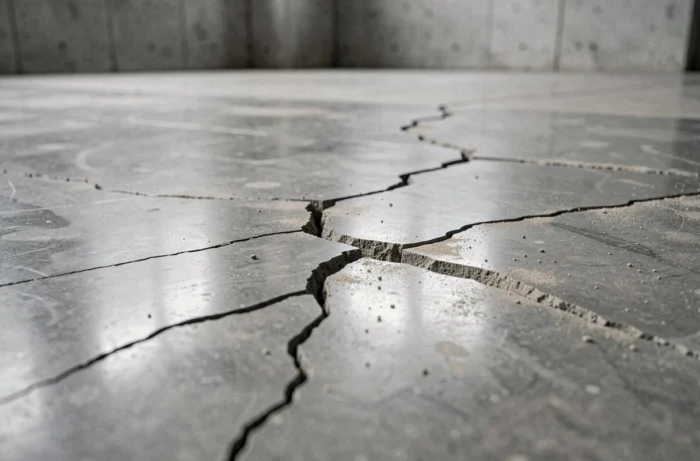
The first structural defect of quartz concrete lies in its sensitivity to movements of the substrate. An active crack in the slab reappears through the quartz finish, regardless of the care taken in the surfacing. Professionals distinguish between superficial micro-cracks, which are generally not serious, and evolving or penetrating cracks that require treatment at the source.
A differential settlement, a poorly positioned expansion joint, or excessive shrinkage of the concrete during drying is enough to cause visible disorders on the surface. Quartz concrete does not mask these movements: it reveals them.
The final quality also heavily depends on the conditions of implementation. Insufficient curing, rapid drying due to wind or sunlight, or high heat increase the risk of shrinkage and cracking. Several resources, including articles on eco habitat, detail these issues to help anticipate common pathologies.
Heat episodes make installation even more demanding. Accelerated setting reduces the working window for incorporating quartz, complicating the smoothing process and increasing the risk of homogeneity defects.
Shrinkage joints and aesthetic constraints of quartz concrete
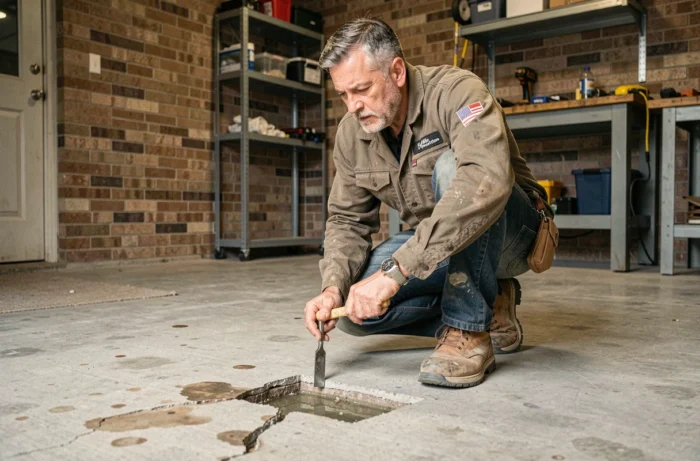
Quartz concrete is often chosen for its continuous appearance, without visible joints. The technical reality contradicts this aesthetic promise. Shrinkage and expansion joints remain necessary to control the movements of the concrete, even with a quartz finish.
These joints, whether contraction or expansion joints, visually interrupt the surface. Their spacing depends on the thickness of the slab and mechanical constraints, but they cannot be eliminated without a major risk of uncontrolled cracking.
Consequences on indoor appearance
In a living room or kitchen, the presence of joints every few meters disrupts the sought-after mineral sheet effect. Unlike a waxed concrete applied in a thin layer (which can sometimes do without certain joints due to its low thickness), mass-cast quartz concrete imposes a technical layout that the visual result must integrate.
This point is rarely highlighted in commercial presentations, even though it significantly alters the final appearance of the floor.
Porosity and maintenance of quartz concrete flooring
Despite its hardness, quartz concrete remains a porous material. Without appropriate surface treatment, it absorbs liquids and retains stains, especially in humid areas like the bathroom or kitchen.
Two types of protection are generally necessary:
- An initial curing compound applied immediately after pouring, to limit evaporation and ensure proper hydration of the cement during setting
- A protective varnish (or pore filler) applied after complete drying, which reduces surface porosity and facilitates regular cleaning
- Regular maintenance through waxing or application of a water-repellent product, depending on the floor’s exposure to chemical and mechanical aggressions
Without this protection chain, chemical aggressions (acidic household products, food splashes) and mechanical aggressions (abrasion, localized impacts) degrade the coating more quickly than tiles or epoxy resin.
Comparison with other flooring materials
Compared to ceramic tiles or resin flooring, quartz concrete requires more regular maintenance to maintain its appearance. The protective varnish must be renewed periodically, which other flooring materials do not require as frequently. This maintenance cost, often overlooked in initial estimates, weighs on the long-term budget.
Repairing and modifying existing quartz concrete
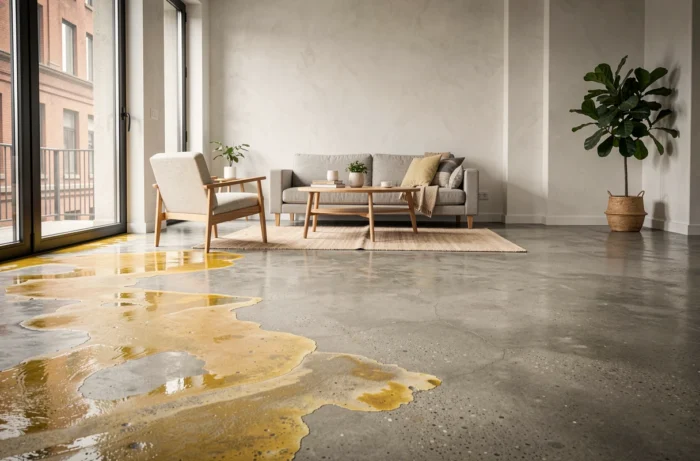
A frequently underestimated defect concerns the difficulty of repair. Locally repairing a damaged area on quartz concrete without making the touch-up visible is a technical challenge. The shade, the grain size of the quartz, and the degree of smoothing vary from one batch to another.
In practice, a partial repair almost always stands out from the rest of the surface. To achieve a homogeneous result, it often requires addressing a much larger area than just the damage, or even resurfacing the entire piece.
Changing the color poses a similar problem. Quartz concrete cannot be easily repainted or re-tinted. Changing its appearance requires sanding the quartz layer or applying a coating over it, which negates the initial advantage of the material.
Before choosing this type of finish, the preparation of the substrate must be impeccable. A prior diagnosis of existing cracks, flatness, and stability of the slab conditions the durability of the result. Climatic constraints during installation, the necessity of joints, and the recurring maintenance costs make quartz concrete a demanding choice, suitable for projects where the rigor of implementation can be guaranteed from pouring to final protection.