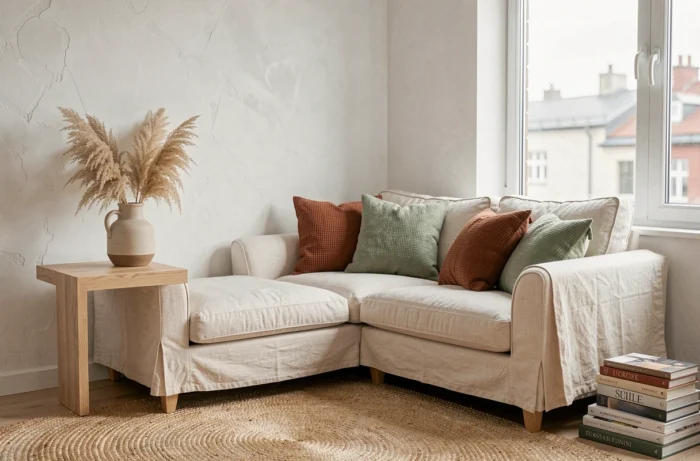
A beige sofa, a white wall, a few gray cushions: the base is clean, but the whole lacks character. This observation often arises when trying to make a home more contemporary without a complete overhaul. Recent decor trends offer concrete ideas for transforming an interior with targeted actions, playing with colors, materials, and some well-thought-out furniture choices.
Color drenching: painting an entire room in the same shade
Have you ever noticed that a single accent wall can seem artificial, as if it was placed there out of obligation? Color drenching proposes the opposite. The principle: apply a single color to the walls, ceiling, and woodwork, sometimes even the radiator.
The effect achieved is enveloping. The room gains depth because the eye no longer stumbles over contrasts between surfaces. A sage green applied everywhere in a bedroom, for example, creates a cocooning sensation that three white walls and one colored wall will never produce.
This technique works particularly well in small rooms. A six-square-meter office painted entirely in navy blue appears larger than with a two-tone treatment because the visual boundaries between wall and ceiling blur. To find ideas for color and furniture combinations suitable for each room, the home site of La Petite Déco offers selections categorized by style and usage.
Color drenching requires neither special technical skills nor a high budget. A few cans of paint, a weekend, and the room radically changes atmosphere.
2026 decor palette: replacing cold gray with earthy tones
For several years, decor palettes have been gradually moving away from cold grays in favor of earthy tones and plant greens. The Pantone color 2026, Cloud Dancer, a luminous off-white, illustrates this shift well: we are no longer talking about pure, clinical white, but about a warm base that welcomes natural shades.
Concretely, this means that the total gray look (gray sofa, gray rug, pearl gray walls) that dominated interiors a few years ago has given way to more vibrant combinations. A living room can combine a terracotta wall, an ecru linen sofa, and olive green cushions without appearing cluttered.
Adapting an existing very gray decor without replacing everything
No need to throw away your gray sofa. Add textiles in warm tones: a ochre throw, clay-colored cushion covers, a rug in sandy hues. Textiles are the quickest lever to warm up a cold room.
On the walls, an off-white paint like Cloud Dancer is enough to break the coldness of a light gray. The operation takes a day per room, and the result transforms the overall ambiance.
Natural materials in the living room and kitchen: wood, stone, linen
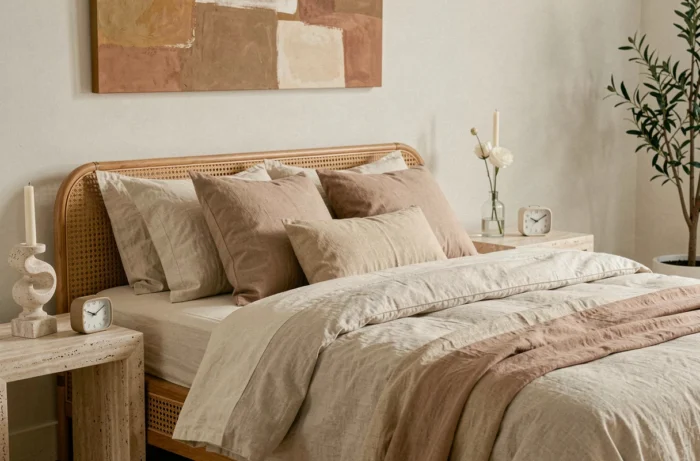
Natural materials are increasingly occupying a place in interior decoration. Wood, stone, linen, and lime are making a strong comeback, not as decorative details but as structural elements of the room.
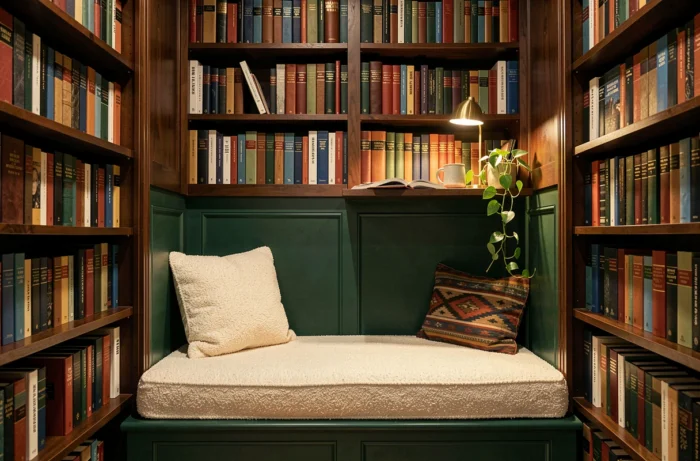
Why this choice? Because these materials bring a texture that laminate or plastic cannot replicate. A solid oak table top ages, patinas, and tells a story. A natural stone backsplash in the kitchen provides a visual anchor that standard tiling does not offer.
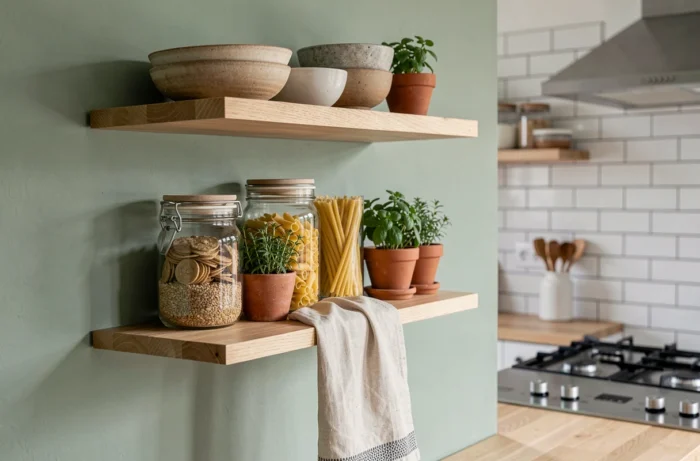
- Raw or lightly oiled wood works just as well on a living room shelf as it does as a kitchen countertop. Prefer local species (oak, walnut, beech) for their grain and durability.
- Linen, in curtains or sofa covers, softens a room while maintaining a raw appearance. It naturally wrinkles, which contributes to the charm of a non-static decor.
- Lime, used as a wall coating, offers a matte and irregular finish that captures light differently depending on the time of day. It advantageously replaces smooth paint in a living room or bedroom.
The combination of several natural materials in the same space creates a sensory coherence. A living room with a wooden floor, a sofa covered in linen, and a wall with lime plaster forms a whole where each surface responds to the others.
Curved furniture and artisanal objects: adding character without overcrowding
Furniture with rounded lines is gaining ground in contemporary interiors. Oval tables, chairs with curved backs, mirrors with organic shapes: curves soften a room dominated by right angles.
A concrete example: replace a rectangular coffee table with an oval or pebble-shaped model. The space around the sofa immediately feels more fluid, circulation in the living room improves, and the room gains visual softness without adding extra objects.
Artisanal objects as an alternative to mass-produced decor
A handmade ceramic vase, a woven basket, a stoneware candlestick: these objects bring a welcome irregularity. The imperfection of an artisanal object creates a point of interest that ten identical candles bought in a set will not produce.
The trap to avoid: accumulating too many small objects on each surface. Two or three well-chosen pieces per area (coffee table, shelf, entry console) are sufficient. The emptiness around an object gives it value. A half-filled shelf will always be more elegant than a saturated one.
Natural light and indirect lighting: two underutilized levers
Light transforms a room just as much as the color of the walls. Increasing natural light remains the most cost-effective decor gesture: removing heavy drapes, replacing opaque curtains with lightweight linen, clearing the space in front of windows.
For artificial lighting, multiplying low light sources radically changes the evening ambiance. A lamp placed on a low piece of furniture, a discreet string of lights on a shelf, a floor lamp directed towards the ceiling: three diffuse light points advantageously replace a single ceiling fixture that flattens the volumes.
Indirect lighting highlights the natural materials mentioned above. A lime plaster wall illuminated by a grazing lamp reveals its texture and micro-reliefs. The same wall under a ceiling neon simply looks poorly painted.
Each action described here works alone, but their combination produces a coherent interior. A living room with terracotta walls, furnished with an oval oak table, illuminated by two low lamps, and dressed in linen needs nothing else to appear both trendy and lived-in.