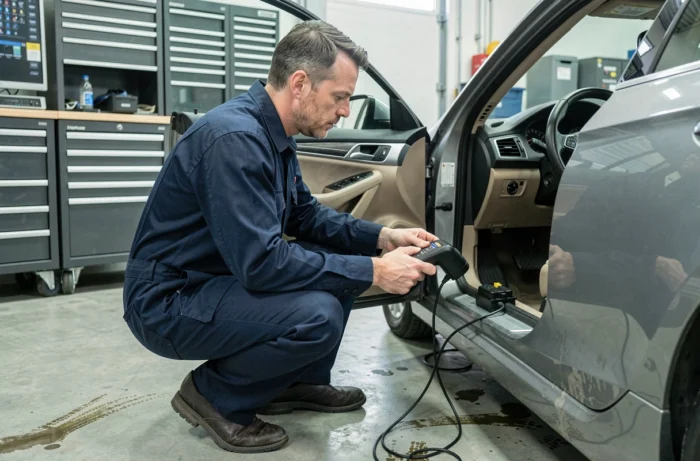
A check engine light coming on the highway, an unexplained loss of power going uphill, an unstable idle when starting cold: the vehicle sends a signal without providing the manual. Automotive diagnostics translate these symptoms into identifiable causes. Between the raw reading of a fault code and the actual location of the fault, there is a gap that only method and the right tools can bridge.
OBD Fault Codes: Why the Code Alone Is Not Enough to Find the Fault
You connect an OBD reader, retrieve a P0420 code (catalytic converter efficiency insufficient), and the natural reflex is to order a new catalytic converter. In most cases, this is a costly mistake. The fault code indicates a value discrepancy detected by a sensor, not the faulty part.
A P0420 can stem from a worn lambda sensor, an exhaust leak upstream of the catalytic converter, or simply a control unit that needs resetting after a battery replacement. The code guides the search, it does not provide the solution.
To go further, you cross-reference the code with real-time data: sensor temperatures, mixture richness, sensor response time. On diagnostique-automobile.fr, you can find resources that detail this correlation approach, which is much more reliable than blind replacement.
The European regulation (EU) 2024/1257, which governs the future Euro 7 standard, reminds us that OBD is a monitoring function and a source of diagnostic information, but does not constitute a comprehensive measure of vehicle compliance. In other words, a clean OBD reading does not guarantee that everything is fine under the hood.
Multi-brand Diagnostic Tool or OBD Reader: Choosing the Right Tool for the Job
The market offers tools at all price points, from OBD readers for around twenty euros to professional multi-brand diagnostic tools that exceed a thousand. The choice depends on what you really want to do.
Basic OBD Reader
It reads and clears standardized engine fault codes (OBD-II protocol). To check a check engine light before going to the garage, it is sufficient. However, it does not access transmission control units, ABS, or airbags.
Intermediate Multi-brand Diagnostic Tool
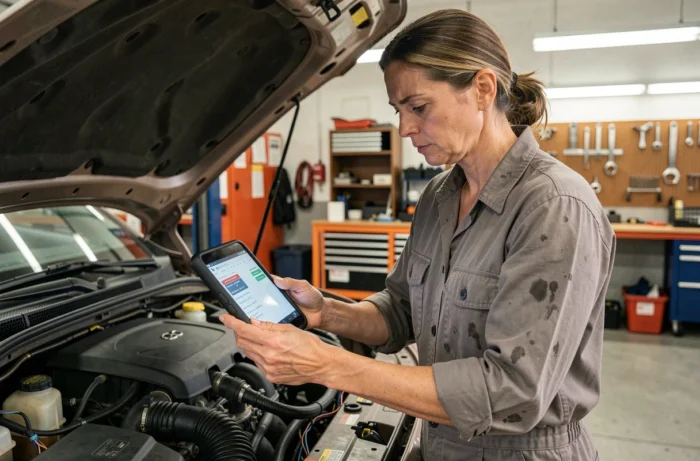
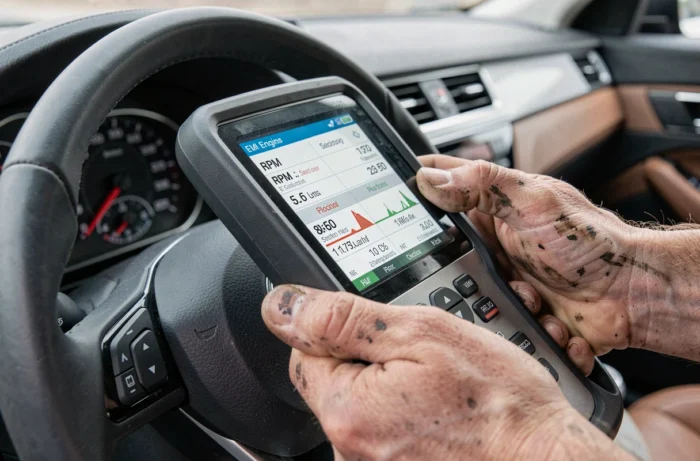
It covers several control units (engine, transmission, ESP, air conditioning) across a wide range of brands. This is the tool suitable for a serious amateur mechanic or a small independent workshop. Access to real-time data changes the quality of the diagnosis: you can observe sensor values while the engine is running and identify abnormal behavior.
Manufacturer Tool or Connected Professional Tablet
Authorized garages use brand-specific tools capable of reprogramming control units, resetting adaptations, and accessing proprietary functions. More and more of these tools integrate cloud connectivity and artificial intelligence algorithms to correlate faults and suggest repair paths.
- OBD Reader: reading/clearing engine codes, suitable for individuals for a quick initial sorting
- Multi-brand Tool: multi-control unit access, real-time data, broad coverage of the vehicle fleet
- Manufacturer Tool or AI-connected platform: reprogramming, in-depth diagnostics, automated fault correlation
Automotive Diagnostics in the Workshop: What the Mechanic Does Beyond the Tool
Entrusting your vehicle to a professional for diagnostics means paying for interpretative skills, not just a simple connection. The technician starts with an interview with the driver: when the symptom appears, under what conditions, and for how long. This information guides the search even before touching a tool.
Next comes the instrumented phase. The mechanic connects the diagnostic tool, reads stored codes and transient codes (those that appear and then disappear). They consult the frozen data, a snapshot of engine parameters at the precise moment the fault was recorded. This frozen data is often more useful than the code itself, as it reveals the context of the fault.
For intermittent electrical problems, the multimeter and oscilloscope take over. A crankshaft position sensor may send a correct signal to the multimeter (resistance within norms) while showing a parasitic spike visible only on the oscilloscope. This is typically the kind of fault that a simple OBD reader will never detect.
OBD Port and Access to Vehicle Data: What Changes with European Regulation
The question of access to diagnostic data has become a major regulatory issue. The Euro 7 framework and discussions around the European Data Act are gradually redefining who can access the information relayed by the vehicle’s control units.
Until now, the OBD-II port offered standardized access to engine and emissions data. Independent garages could connect their tools without restriction. With the rise of connected vehicles, an increasing portion of the data now passes through manufacturer servers, raising questions about equal access between authorized networks and independent workshops.
For independent repairers as well as equipped individuals, this evolution means that a high-performing diagnostic tool today could lose some of its functionalities tomorrow if the manufacturer restricts access to certain data streams. Feedback on this point varies by brand and market, but the trend towards data centralization is clear.
- The OBD port remains mandatory and provides access to standardized emissions data
- Advanced data (telematics, updates) increasingly passes through the manufacturer’s cloud
- The European Data Act aims to ensure equitable access to data for independent repairers
Regardless of the tool used, automotive diagnostics remains primarily a logical process: observe a symptom, formulate a hypothesis, verify it through measurement, and only then intervene. Replacing a part without confirming that it is the cause is like playing guessing games with your budget. Technology evolves quickly, tools improve, but this methodical rigor remains the best investment for maintaining a vehicle without unpleasant surprises.