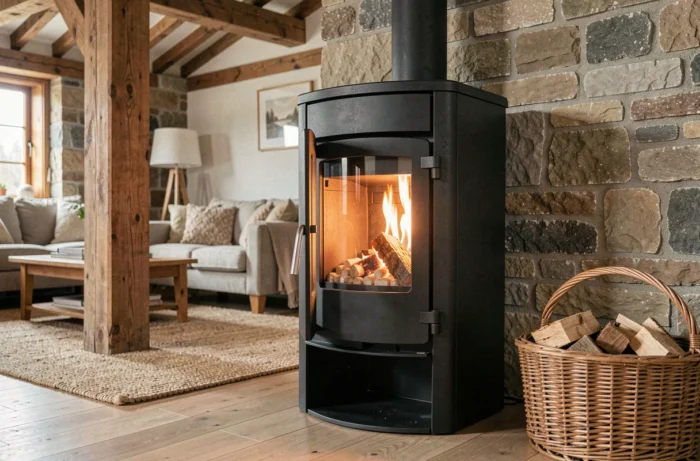
A bag of wood pellets weighs about fifteen kilos, is stored in a garage, and fuels a stove or boiler for several hours without intervention. This fuel, made from sawdust and wood chips recovered from sawmills, has established itself as a credible alternative to gas and oil. Pellet heating combines high efficiency, controlled costs, and a favorable carbon footprint—three arguments that deserve to be detailed.
Pellet Efficiency: Why Combustion is So Effective
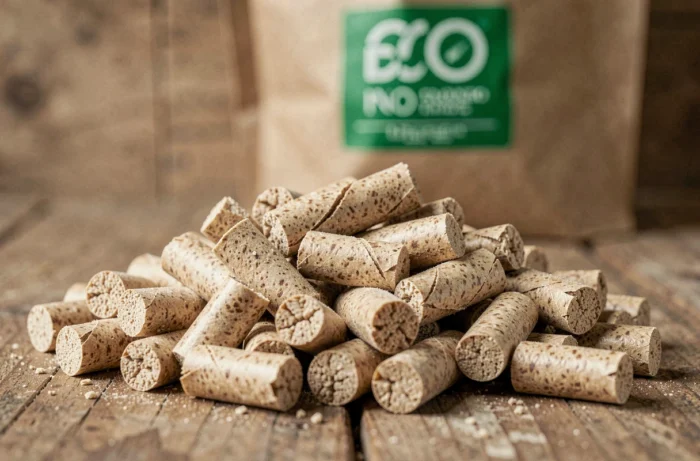
You may have noticed that a traditional fireplace mainly heats the room it is in, and even then, in an irregular manner? Pellets work differently. Their calibrated shape (a few centimeters long, about six millimeters in diameter) and low moisture content allow for almost complete combustion.
In practical terms, a pellet stove or boiler achieves very high efficiency, often exceeding that of traditional logs. The energy contained in the fuel is transformed into useful heat instead of going up in smoke. Less residue, less ash, less waste.
Automatic feeding also plays a role. An auger system continuously doses the pellets, maintaining a stable temperature. No manual restarting, no sudden fluctuations. To delve deeper into how these devices work and compare available models, a useful resource: https://chauffage-pellets.org/.
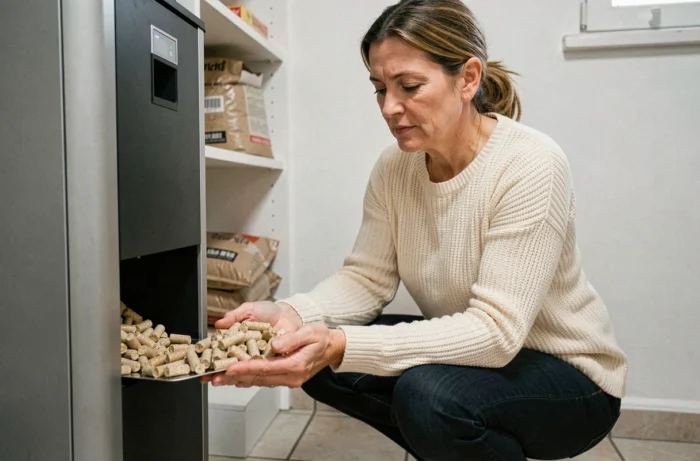
Wood Pellet Prices: Competitiveness Regained After the Crisis
The surge in energy prices in 2022-2023 affected all fuels, including pellets. Many households hesitated to invest during this period. The situation has changed significantly since then.
According to the Selectra barometer, the price of bulk pellets has dropped to around 347 euros for the 2024-2025 school year, with a limited winter peak. This stabilization restores the competitiveness of pellets against gas and oil.
What Makes Pellets Economically Attractive Over Time
The price of the fuel is not everything. The lifespan of a pellet boiler is long, and its maintenance remains reasonable (annual chimney sweeping, regular cleaning of the ash container). The initial investment is indeed higher than that of a gas boiler, but financial aid exists to reduce the bill.
- MaPrimeRénov’ covers part of the installation cost for biomass boilers, subject to income conditions and device performance.
- Energy savings certificates (CEE) provide additional financial support, sometimes combinable with MaPrimeRénov’.
- Some local authorities offer additional aid, varying by region.
By adding these schemes together, the out-of-pocket expense can decrease significantly, especially for households with modest incomes.
Carbon Footprint of Pellets: Neutrality or Almost
Wood pellets are made from by-products of the wood industry. No tree is specifically cut down to produce pellets. This point changes the game environmentally.
During combustion, the CO2 released corresponds to what the tree absorbed during its growth. We talk about short carbon cycle, as opposed to fossil carbon stored for millions of years in gas or oil. The net balance is nearly neutral, provided that the source forests are managed sustainably.
Forest Certifications and Traceability
The PEFC and FSC labels guarantee that the wood comes from forests where tree renewal is ensured. For consumers, buying pellets certified DINplus or ENplus offers a double guarantee: product quality (calorific value, ash content, moisture) and traceability of the raw material.
2026 Regulations on Wood Heating: What the New PPA Changes
Since January 1, 2026, communities covered by an atmospheric protection plan (PPA) prohibit the use of wood heating devices installed before 2002. This measure targets open fireplaces and old stoves, responsible for high fine particle emissions.
Certified automatic pellet boilers are not affected by these restrictions. Their controlled combustion and low emission levels place them in the category of high-performance devices recognized by authorities.
Why this distinction? An open fireplace emits far more fine particles than a modern pellet stove. The PPAs do not target wood energy as a whole, but obsolete technologies. Choosing a modern pellet device means complying with regulations without the risk of future bans.
Daily Use Comfort: Programming and Autonomy
A rarely detailed argument in classic comparisons: daily management. A pellet stove can be programmed like a central heating system. Set temperature, time slots, delayed start—all can be adjusted via a control panel or an app.
- The autonomy of a stove varies from a few hours to several days depending on the tank capacity and the power demanded.
- A pellet boiler with a silo can operate for several months without manual reloading.
- The noise level of recent models remains moderate, comparable to that of a refrigerator for naturally convective devices.
Programming your pellet heating allows you to reduce consumption without sacrificing comfort. Automatic regulation prevents overheating and late restarts, two common sources of waste with manual systems.
Pellet heating is not a perfect choice for all homes. A storage space is still necessary, and the initial investment requires serious calculation. For single-family homes and properties with a technical room, the balance between cost, comfort, and environmental impact clearly favors pellets, especially since the stabilization of prices and the tightening of regulations on old devices.