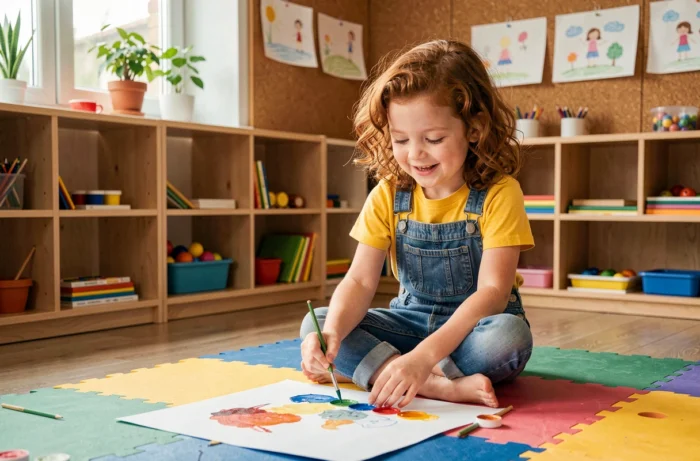
A playful and educational space for children refers to a place designed to combine free play and structured learning, in an environment adapted to the motor, sensory, and cognitive abilities of young users. These spaces are distinguished from simple playgrounds by their educational dimension: each area, each activity serves a specific developmental goal, whether it be fine motor skills, socialization, or sensory stimulation.
Inclusive multisensory spaces: what changes since 2025
Playful and educational activities for children have recently taken a turn with the emergence of spaces designed from the outset to accommodate all profiles, including children with special needs. The model no longer merely adheres to minimal accessibility standards: it incorporates specific devices in each play area.
In Montpellier, the Sensoria park, opening in the summer of 2026, illustrates this approach. The space offers an immersive mini-city, an interactive tactile wall, and a sensory room dedicated to calming down. The corridors are widened beyond usual standards, and communication tablets as well as pictograms are made available for non-verbal children.
In Agen, La Cabane d’Alba, opening in 2026, targets children aged 0-10 by aligning its progression with the cycles of the National Education system. Separate areas for toddlers ensure safety while allowing older children to engage in more complex educational activities. This type of place, where one can find an offering comparable to Station Kids, combines immersive play with concrete educational objectives.
This trend reflects a strong demand from parents and early childhood professionals: a play space that does not sacrifice learning for fun, nor the reverse.
Educational activities for children: the role of free play in development
Free play, as opposed to guided play, allows the child to choose their activity, pace, and partners. In a well-designed playful space, this freedom does not equate to chaos: it relies on a prepared environment where each element has a function.
Skills developed through free play in a dedicated space
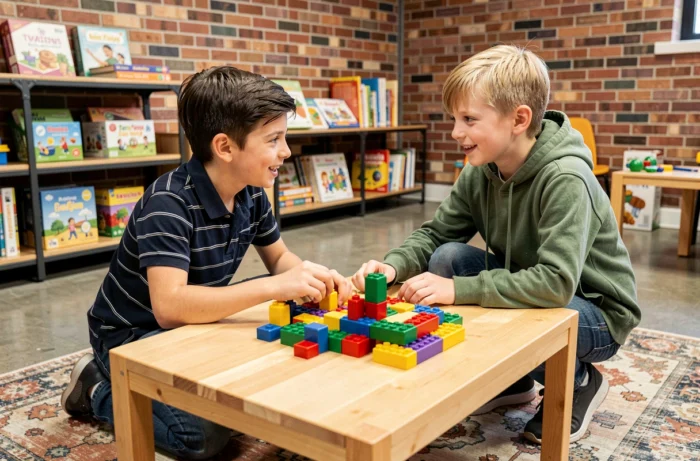
A child manipulating building blocks in a designated area works on their fine motor skills and spatial representation. One who negotiates a role in a mini-city game develops social and language skills without direct adult intervention.
The deliberately distant activity from formal school learning allows the child to mobilize other cognitive resources. Free play activates problem-solving circuits that guided learning does not engage in the same way.
The distinction between free play and directed activity deserves to be understood by parents: both are complementary, but free play activates problem-solving circuits that guided learning does not engage in the same way.
Quality criteria for a children’s play space
Not all spaces dedicated to children’s activities are equal. A few criteria can help evaluate the relevance of a place before taking children there.
- Separation of age groups: a space that mixes 0-3 year-olds and 6-10 year-olds without partitioning exposes the younger ones to collision risks and limits the quality of play for the older ones.
- Presence of calm or sensory areas: a quiet room, a reading corner, or a sensory device (textures, sounds, soft lights) meets the needs of hypersensitive or tired children.
- Rotation and variety of activities: a space that offers the same modules all year round loses its educational interest. The most developed places renew their workshops or installations by season.
- Support from a trained team: the presence of facilitators or educators capable of guiding without directing makes the difference between a daycare space and a true learning environment.
These criteria are not always listed on the websites of the relevant spaces. Observing the layout of the places during a first visit remains the most reliable way to assess their quality.
Montessori approach and active pedagogies in play spaces
Several recent playful spaces claim Montessori inspiration or rely on active pedagogies (Reggio Emilia, Freinet). In practice, this translates into specific layout choices.
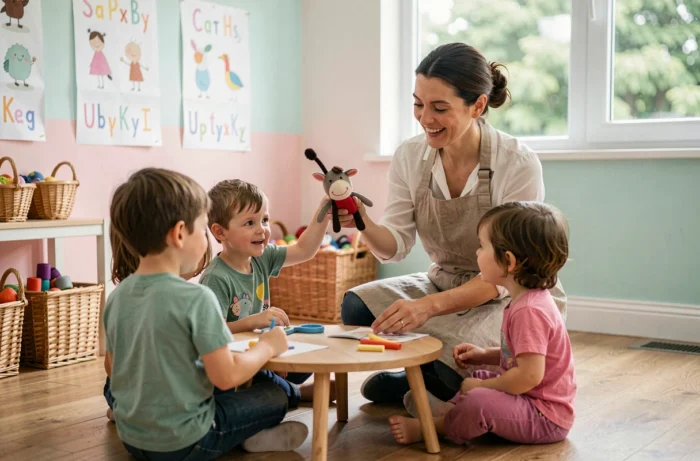
The furniture is child-height, activities are accessible in self-service, and the preferred materials are natural (wood, fabric, metal). The adult intervenes only when the child requests it or when safety requires it. The child chooses their activity and the duration of their engagement.
This approach requires a more favorable adult-to-child ratio than in a traditional playground. It also assumes specific training for the team, capable of distinguishing a child in difficulty from a child simply in an observation phase, which is part of the Montessori learning process.
Since the term “Montessori” is not protected, some spaces use it as a marketing argument without actually applying the method. A concrete indicator: check if the proposed activities correspond to the sensitive periods described by Maria Montessori (order, movement, language, sensory refinement) rather than a simple provision of wooden toys.
Choosing a space suitable for your child’s age and needs
A two-year-old and a seven-year-old do not derive the same benefits from the same space. For toddlers, the priority is on sensory activities and gross motor skills (crawling, climbing, manipulating). For school-aged children, role-playing games, creative workshops, and collaborative challenges take over.
A good educational space offers at least three distinct universes corresponding to different developmental stages. Parents benefit from identifying their child’s primary need at a given moment (need for movement, calm, socialization) before choosing a place.
The spaces that work best are those where the child willingly returns, not because the place is spectacular, but because they find a readable, predictable environment that is rich enough to renew their exploration with each visit.