Generalist aggregators and lifestyle Instagram accounts are no longer sufficient to capture a fashion trend before it saturates the market. The speed of collection renewals, driven by the TikTok-to-retail cycle, requires more technical monitoring methods. Identifying the latest online fashion trends today demands a combination of trend intelligence tools, a keen reading of weak signals on social media, and rigorous filtering of sources.
Trend velocity and AI tools: spotting a fashion trend before the peak
The most actionable data for anticipating a trend is not its raw volume of mentions, but its growth rate over a short window. This is what the industry calls trend velocity. Platforms like Trendalytics or Spate continuously cross-reference Google search data and TikTok signals to measure this acceleration, sometimes several months before traditional fashion media report on the phenomenon.
Trendalytics analyzes tens of billions of searches and tens of millions of TikTok videos. The result takes the form of prediction-oriented dashboards, capable of isolating micro-trends in the explosive phase and projecting their trajectory over twelve months across fashion, beauty, and lifestyle categories.
We recommend not limiting yourself to generic terms (“midi dress,” “chunky sneakers”). The most revealing queries focus on specific attributes: a color, a cut detail, a type of print. It is on these micro-signals that monitoring becomes truly predictive, and this is where it becomes relevant to search for trends on FashionUp to cross these signals with updated editorial coverage.
Computer vision applied to online fashion: beyond hashtags
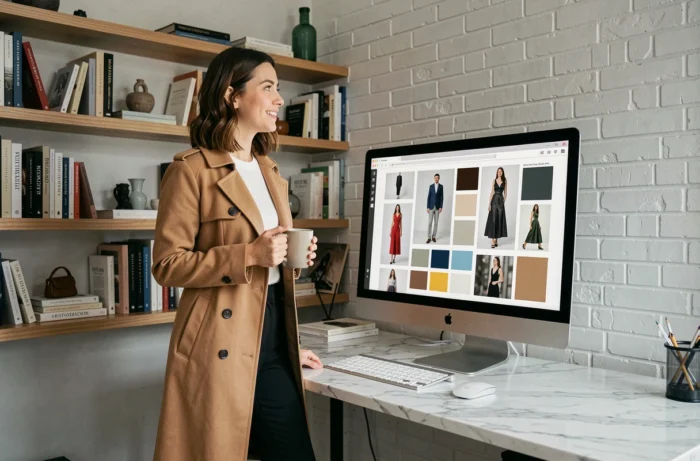
Tracking hashtags on Instagram or TikTok remains a superficial approach. A hashtag reflects what the user claims, not what they actually wear. Computer vision changes the game.
Heuritech, for example, ingests around one million social posts per day. Its algorithms recognize over 2,000 fashion attributes (prints, colors, shapes, product details) directly from images, without relying on the associated text. This capability allows for demand prediction up to a year in advance.
The interest for a fashion monitor is twofold:
- To detect a rising color or silhouette in streetwear photos before a media outlet names it or a hashtag crystallizes.
- To quantify the actual spread of a style in a geographic area or age group, rather than relying on the subjective impression of a news feed.
- To compare the gap between what is buzzing online and what is actually selling, to distinguish between viral trends and commercially viable trends.
Solutions like Stork AI push this logic further by offering reverse visual search: you upload a photo of clothing, and the tool identifies similar pieces available online, along with their references and associated stores.
Filtering fashion sources: weak signals versus editorial noise
The majority of online trend articles compile the same fashion shows and the same influencer accounts. To move faster, we observe that it is necessary to structure monitoring around three distinct layers.
Predictive layer
The trend intelligence tools mentioned above (Trendalytics, Spate, Heuritech) form the foundation. They provide quantified data on the trajectory of a trend. Without search data, a fashion intuition remains an opinion.
Selective editorial layer
Rather than following twenty fashion blogs, we recommend targeting media that publish data analyses, not just lookbooks. Brand newsletters remain useful for capturing launches in advance, but they do not replace critical reading.
Community layer
Specialized subreddits (like r/fashionwomens35) and certain fashion Discord groups offer ground-level feedback that professional platforms do not capture. Discussions there focus on pieces actually bought and worn, not on sponsored looks.
The classic trap is to confuse content volume with relevance. A style photographed by fifty influencers in product placement the same week is not an emerging trend; it’s a marketing campaign.
Concrete method for quick fashion trend monitoring
Structuring an effective monitoring routine does not require more than fifteen minutes a day, provided you automate the right feeds. Here is the protocol we apply:
- Set up alerts on Trendalytics or Google Trends for targeted fashion attributes (type of fabric, color palette, collar shape) rather than for generic piece names.
- Check visual search results on Pinterest Trends once a week, filtering by country and category, to spot discrepancies between markets.
- Systematically cross-reference a TikTok signal with a Google Search signal: a trend confirmed on both channels has a much higher retail conversion probability than a buzz isolated on a single network.
- Archive the pieces identified in a private Pinterest board or a spreadsheet with the date of first detection, to measure the delay between weak signal and mainstream adoption.
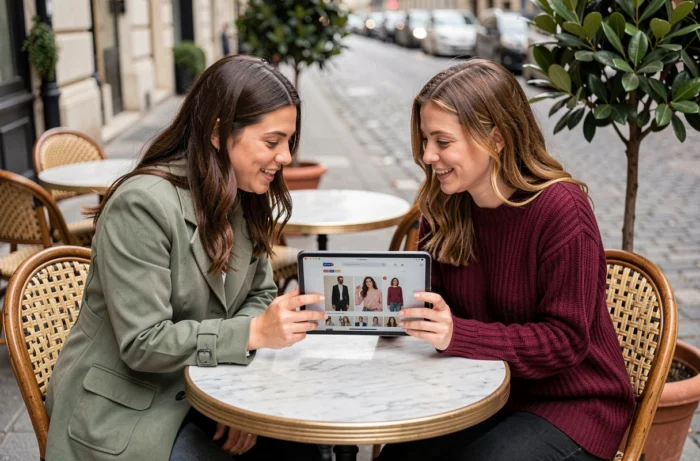
The visual shopping application (like Stork AI or Google Lens) complements this setup. When you spot a piece in a streetwear look, the reverse search immediately identifies the versions available in online stores, with price comparisons.
The real time-saving does not come from a single tool, but from the articulation between search data, automated visual analysis, and targeted editorial curation. Monitors who rely on a single channel remain subject to its algorithmic bias. Those who cross three distinct sources identify online fashion trends several weeks ahead of the traditional media cycle.