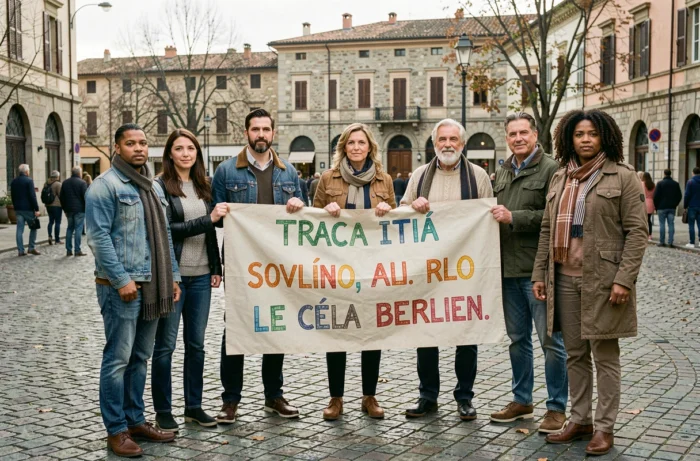
When thousands of people chant “Siamo tutti antifascisti” in the streets of Paris, Lyon, or Marseille, the question of translation arises concretely. Translating this Italian slogan into French is not just a linguistic exercise: the choice of words engages a political position, and the inclusive variants that have circulated in recent years modify the meaning of the message as much as its reach.
What the “tutti” changes when translated into French
In Italian, “tutti” is a masculine plural that, by grammatical convention, encompasses an entire mixed group. French works the same way with “tous.” The literal translation thus gives “we are all antifascists,” a phrase already used in French marches.
The problem appears in the activist field. The generic masculine no longer satisfies part of the antifascist movements, particularly those that articulate their struggle with feminist or LGBTQIA+ demands. It is in this context that inclusive variants have emerged, first in Italian, then in French. As detailed in articles published on Perspective Media, these adaptations reflect a broader debate about language as a political tool.
The magazine La Déferlante dedicated an article to the phrase “Siamo tuttx antifascistx,” where the “x” replaces gendered endings. This “x” comes from inclusive writing practiced in Italian and Spanish-speaking queer circles. In French, there are equivalents: “tou·tes,” “tous et toutes,” or even “touxtes.”

Inclusive variants of the antifascist slogan: concrete forms and contexts of use
The variants are not interchangeable. Each corresponds to a context of use, a medium, and a target audience. Here are the most documented forms:
- “We are tou·tes antifascists”: form with a middle dot, common on leaflets and visuals from antifascist feminist collectives in France. The middle dot is readable in writing but poses a pronunciation problem during demonstrations.
- “We are all and all antifascists”: long form, more accessible orally, used in public speeches and press releases. It lengthens the slogan, making it less impactful in collective singing.
- “Siamo tuttx antifascistx”: inclusive Italian form with the “x,” kept as is in some French marches to maintain the direct reference to Italian antifascism. It is notably found in mobilization visuals that mix antifascist, LGBTQIA+, and pro-Palestinian struggles.
The choice between these forms depends on the medium. On a banner, conciseness prevails. In an opinion piece, the developed form works better. Orally, “tutti” remains the most shouted version, even by activists who use inclusive writing in writing.
Transnational circulation of the slogan: from Italy to the German rap scene
The slogan does not only circulate between Italy and France. In 2023, German rapper Disarstar released a track titled “Siamo tutti,” explicitly incorporating “Siamo tutti antifascisti” in its chorus. Videos from his concerts show crowds chanting the slogan in Italian, even though the audience is German-speaking.
This detail matters: the slogan functions as a transnational rallying cry that transcends language barriers. The choice not to translate, to keep it in Italian, constitutes a political stance in itself. It connects contemporary antifascist struggle to its Italian roots from the 1920s, when the term “antifascist” appeared in the press.
In France, this circulation intensified during the mobilizations of summer 2024, between the two rounds of the legislative elections. The slogan was massively adopted in leftist marches and local antifascist fronts. It was no longer a simple Italian cultural import, but a political reappropriation rooted in a French electoral context.

Translating an antifascist slogan: the limits of the inclusive exercise
Inclusive writing applied to a protest slogan faces a constraint that online debates often underestimate: collective chanting. A slogan works if it can be shouted in unison by several hundred people without hesitation.
“We are tou·tes antifascists” poses a concrete phonetic problem. The middle dot is not pronounced uniformly. Some say “toutes,” others “tou-tes” with a micro-pause, and still others “tous.” In a demonstration, this heterogeneity breaks the collective rhythm.
This is probably why the original Italian version persists in French marches. Italian offers a pragmatic solution: by keeping “tutti,” the debate on gender in French is avoided while displaying transnational solidarity. Feedback varies on this point, but observations of recent mobilizations confirm the coexistence of both approaches: Italian orally, inclusive French in writing.
What the choice of language reveals in a march
Chanting in Italian rather than in French is not an aesthetic reflex. It is a political act that inscribes the mobilization in a precise historical lineage. Antifascism as a political category was born in Mussolini’s Italy, and the Italian language carries this memory. Translating also risks diluting this reference.
Conversely, translating into inclusive French asserts that contemporary antifascism cannot simply reproduce the forms of the past. Movements that use “tuttx” or “tou·tes” claim an antifascism that integrates struggles against patriarchy and gender discrimination, not just against historically authoritarian regimes.
The slogan “Siamo tutti antifascisti” continues to circulate in all these forms, in Italian, in French, with or without inclusive writing. Each variant translates a political positioning as much as a linguistic choice, and it is precisely this plasticity that explains the longevity of the rallying cry, a century after its emergence.